

Feroza, known internationally as Turquoise, is one of the most widely worn gemstones among Muslims across Pakistan, Iran, and the wider Muslim world. Yet most people searching for Feroza Stone Benefits in Islam end up on generic crystal-healing pages that say nothing about permissibility, tradition, or how it is actually meant to be worn. This guide takes a different approach. It looks specifically at whether Feroza is halal, the traditional significance behind it, how it should be worn according to Islamic custom, and who typically chooses it — with a dedicated breakdown of pricing and identification available in our full Feroza stone meaning and price guide.
Is Feroza (Turquoise) Halal in Islam?
Wearing natural gemstones is a well-established part of Muslim tradition, not something introduced from outside it. Many scholars point to the general permissibility of natural stones set in silver, following the well-known example of Aqeeq (carnelian), which is commonly worn by Muslims worldwide. Feroza falls into this same broad category — a natural stone, free of any specific religious prohibition, that has been worn by Muslims across Persia, the Middle East, and South Asia for centuries.
A few points are worth understanding when it comes to Is Feroza Halal in Islam:
- Men traditionally wear Feroza rings set in silver rather than gold, in keeping with general guidance around men’s jewellery in Islam.
- Women have more flexibility and commonly wear Feroza in gold or silver, whether as rings, pendants, or earrings.
- Feroza is not tied to any specific chant or ceremony before it can be worn — it is simply a natural gemstone, worn with the correct intention (niyyah), the same reasoning applied to other natural stones across the Muslim world.
As with any matter of religious practice, individuals with specific concerns are encouraged to consult a trusted local scholar, since guidance can vary slightly depending on personal circumstances and school of thought.
Feroza’s Significance in Islamic Tradition
Feroza carries a long-standing association with Hazrat Ali (RA) in Shia and broader Muslim tradition, and rings set with the stone have historically been popular among Muslims in Persia, the Middle East, and South Asia. It is also one of the most common stones used for tasbih (prayer beads), valued for its calming blue-green colour during dhikr and prayer.
Because there is genuine scholarly variation in how specific narrations about gemstones are graded, we present this as widely held cultural and traditional belief rather than a definitive religious ruling. In Pakistani and South Asian Muslim communities specifically, Feroza is commonly gifted at weddings, births, and religious occasions as a symbol of protection and blessing — a tradition passed down through generations rather than a scripted requirement
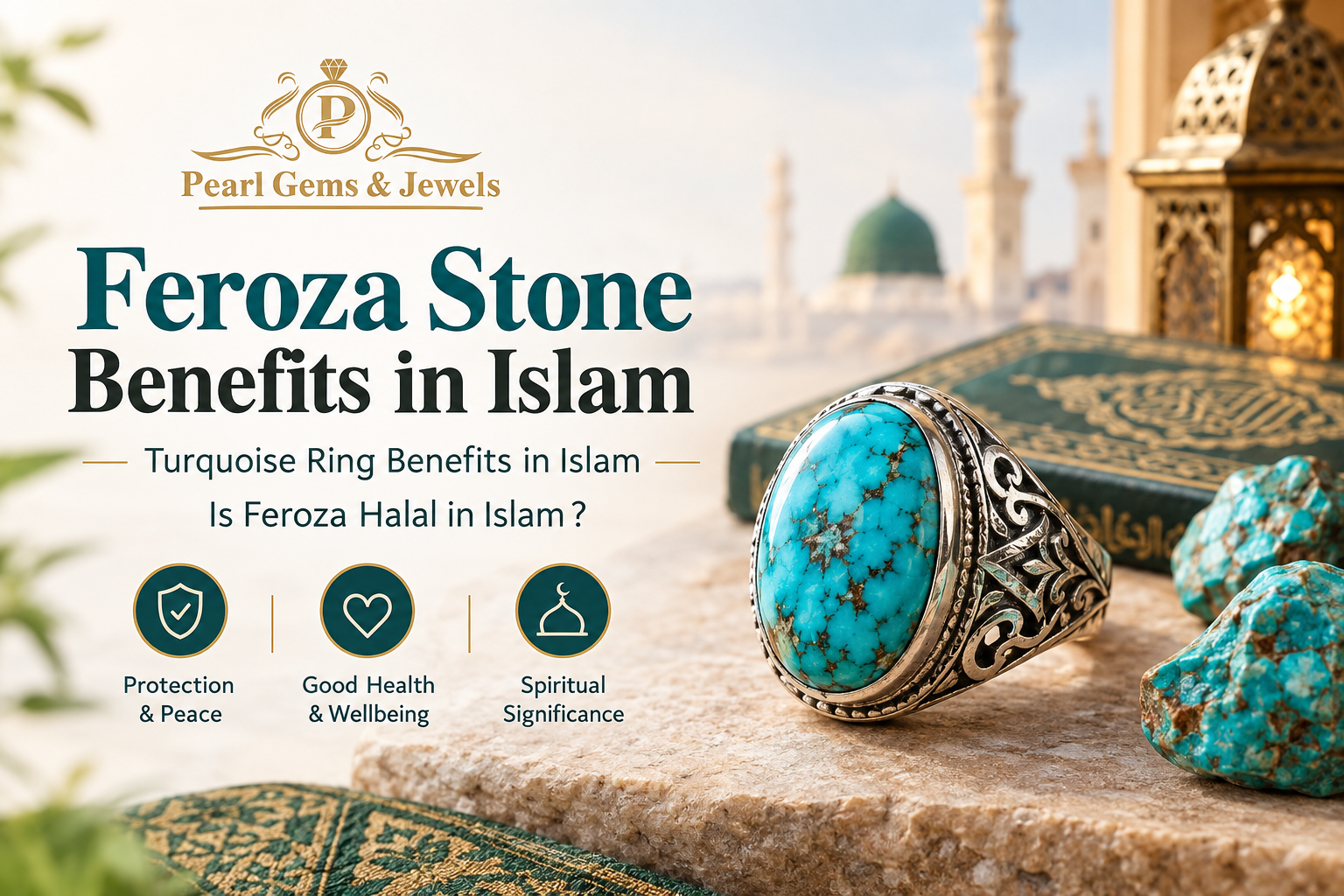
Traditional Benefits of Wearing Feroza in Islam
Across Pakistani, Persian, and broader Islamic tradition, Feroza — also spelled Firoza — has been associated with a consistent set of traditional benefits. These are best understood as cultural belief and lived tradition, not medical or scientific claims, and are shared here in that spirit.
Protection from nazar (evil eye). Feroza is one of the most widely recognised protective stones in Persian, Middle Eastern, and South Asian Muslim tradition, believed to guard the wearer against envy and negative attention.
Barakah in wealth and business. Many Pakistani gemstone traditions associate Feroza with barakah — blessing — in financial and career matters, which is part of why it remains popular among traders and shopkeepers.
Clarity in speech. Feroza is traditionally linked to confidence and clear communication, and some wearers describe feeling more articulate and composed while wearing it.
A safe travel companion. Historically, Feroza was carried by travelers and soldiers as protection on journeys, a belief that persists in South Asian gemstone culture today.
It is worth being direct here: these are traditional beliefs held by many Firoza Stone Benefits in Islam searchers and wearers across Pakistan, not guarantees. Anyone wearing Feroza can appreciate both the cultural tradition behind it and the simple fact that it is a beautiful, historically significant gemstone in its own right.
How to Wear Feroza According to Islamic Tradition
Metal. Silver, not gold. Gold jewellery for men is prohibited in Islam, which is one of the main reasons silver-set Feroza rings have remained the standard choice for Muslim men for centuries. Women may wear Feroza set in gold or silver.
Which Finger to Wear Feroza Ring. Tradition among many Muslims follows the practice associated with the Prophet’s (PBUH) own ring, worn on the right hand’s smallest finger. Some communities and schools of thought differ on the exact hand or finger, so local custom and scholarly guidance both play a role — if in doubt, ask a scholar familiar with your community’s practice.
Intention (niyyah). Many wearers pair putting on the ring with a short dua or intention for protection and blessing, rather than treating the stone as having independent power of its own. The belief, consistently, is that Allah has placed blessing in His creation — not that the stone acts independently.
Feroza Ring for Men in Islam
A Feroza Ring for Men in Islam is one of the most recognisable pieces of Islamic jewellery across Pakistan, particularly within Baloch and Pashtun tradition, where Feroza appears in men’s rings, tasbih, and even ceremonial ornaments. The standard setting is sterling silver with an open or semi-open back so the stone can sit close to the skin, following the same wearing tradition used for Aqeeq and other Sunnah-associated stones.
Buyers exploring Feroza rings alongside other Islamic options often also consider Aqeeq and Dur-e-Najaf — our Islamic Gemstones guide compares all three in detail, including price ranges and which stone suits different intentions.
Who Should Wear Feroza?
Unlike astrological systems that restrict certain stones to specific birth charts or dates, there is no such restriction in Pakistani Islamic tradition. Feroza is worn broadly by:
- People drawn to its traditional associations with protection and barakah
- Travelers and professionals who value its association with safe journeys and clear communication
- Those who simply love its sky-blue colour and centuries-old heritage
- Business owners, given its strong traditional association with financial blessing
If you are new to Feroza, a practical approach is to wear it for a few weeks and see how it feels, choosing based on comfort and personal preference alongside advice from a trusted, experienced jeweller.
Genuine vs Fake Feroza — What to Check Before Wearing
Because Feroza carries religious and cultural weight for many wearers, authenticity matters more here than with purely decorative jewellery — a dyed or synthetic stone worn with Islamic intention is still, materially, not the natural stone the tradition refers to. At a glance, genuine Feroza feels cool to the touch, shows natural variation rather than perfectly uniform colour, and is usually accompanied by a natural-stone guarantee from the seller.
For the full breakdown of grading, treatments, and 2026 pricing per carat and ratti, see our complete Feroza stone meaning, healing properties, and price guide.
Caring for Your Feroza the Right Way
Feroza is a soft, porous stone, and a few Islamic etiquette points overlap with practical care. It is customary to remove a ring worn for religious intention before entering the bathroom, out of respect for the intention behind it — and this also protects Feroza from the humidity that can dull its colour over time. Beyond that, keep it away from perfume, lotion, and prolonged water exposure, and wipe it with a soft dry cloth after wearing.
Frequently Asked Questions
Is Feroza haram in Islam? No. There is no specific prohibition on wearing Feroza. Like Aqeeq, it is widely worn by Muslims in Pakistan and beyond, typically set in silver for men and silver or gold for women.
Can men wear Feroza rings in Islam? Yes, traditionally in a silver setting. This is one of the most common ways Feroza is worn across Pakistani Muslim communities, particularly in Baloch and Pashtun tradition.
Which finger should Feroza be worn on? Many Muslims follow the tradition associated with the Prophet’s (PBUH) ring, worn on the right hand’s smallest finger. Local custom varies, so it’s worth checking with a scholar familiar with your community’s practice.
Is Firoza the same as Feroza? Yes. Firoza and Feroza are simply two common spellings of the same Persian-derived word for Turquoise, used interchangeably across Pakistan, Iran, and South Asia.
Does Feroza need to be blessed before wearing? No. Unlike some astrological traditions that call for specific rituals before a gemstone can be worn, there is no such requirement in Islamic practice. Many wearers simply say a short dua with sincere intention when putting it on.
What are the main Turquoise Ring Benefits in Islam? Traditionally, protection from the evil eye, barakah in wealth and business, and support for clear, confident communication — understood as cultural tradition rather than guaranteed outcomes.