

Sulemani Aqeeq price in Pakistan varies widely — and if you do not know what you are looking for, you will almost certainly overpay or end up with a fake. Whether you are a seasoned gemstone collector, a jewelry maker sourcing stones for your workshop, or a first-time buyer seeking an original Sulemani Hakik ring, understanding the market is essential before spending a single rupee.
At Pearl-Gems, we work with certified natural gemstones and speak directly with buyers every day. This guide gives you a transparent, up-to-date breakdown of current Sulemani Aqeeq prices in Pakistan, the factors that drive those prices up or down, how to verify authenticity, and exactly what to look for when making your purchase in 2026.
What Is Sulemani Aqeeq?
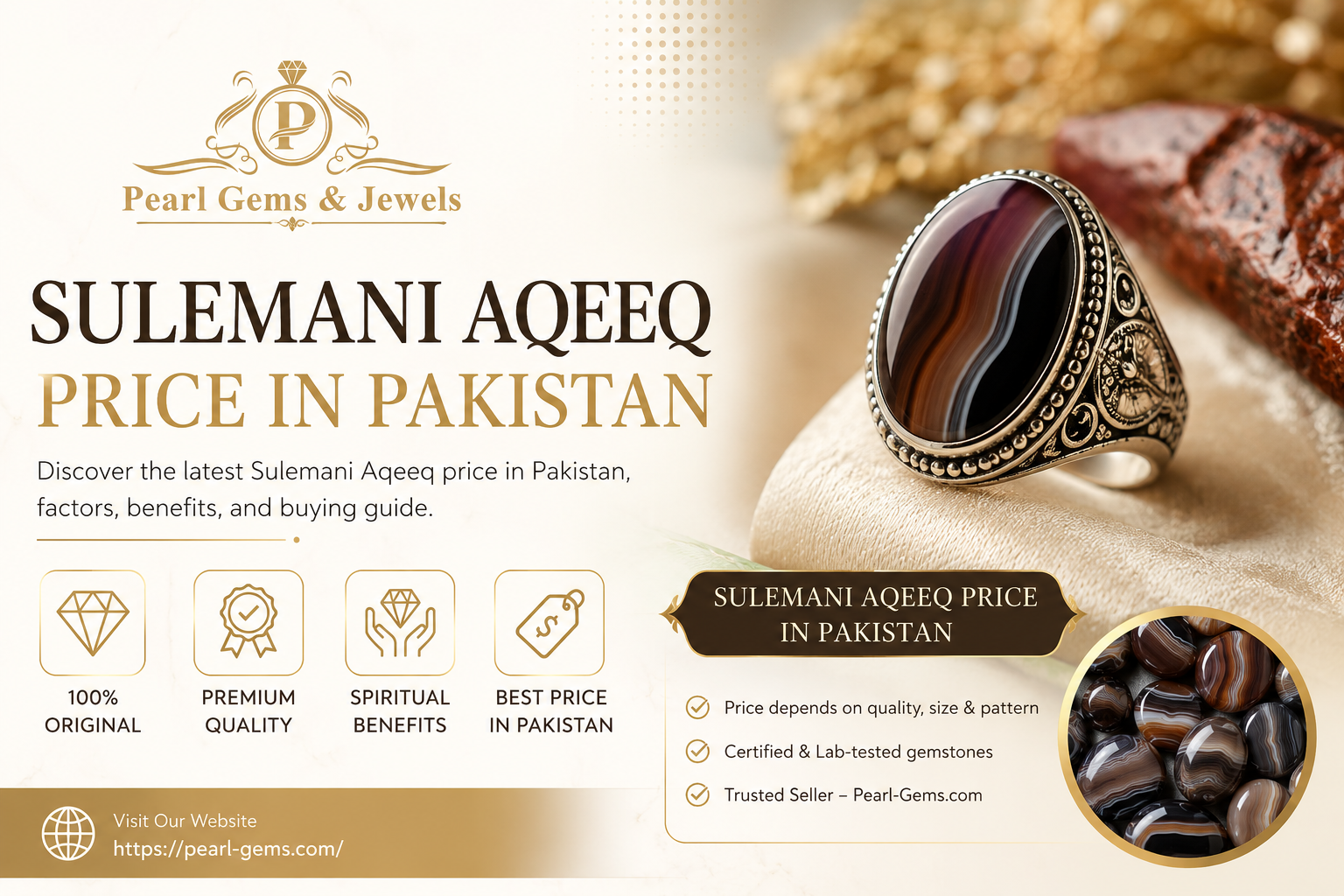
Sulemani Aqeeq — also written as Sulemani Hakik, Suleimani Agate, or Sulemani Akik — is a variety of banded agate belonging to the quartz mineral family. It is one of the most recognizable gemstones in South Asia and the Muslim world, distinguished by its natural layered patterns of black, grey, white, and brown. No two stones carry identical bands, which makes every piece genuinely unique.
The stone is named after Hazrat Sulaiman (A.S.) and carries deep cultural and spiritual significance across Pakistan, Iran, Turkey, and throughout the Arab world. In Islamic tradition, wearing Aqeeq is considered a Sunnah of the Prophet Muhammad (Peace Be Upon Him), which is why demand for this stone in Pakistan remains consistently high across all social and economic classes.
From a gemological standpoint, Sulemani Aqeeq is a cryptocrystalline form of silica with a hardness of 6.5 to 7 on the Mohs scale, making it durable enough for daily wear in rings, pendants, and tasbeehs.
Sulemani Aqeeq vs Other Aqeeq Types: Key Differences
Before discussing price, it is important to understand where Sulemani Aqeeq sits within the broader Aqeeq family. Buyers frequently confuse different varieties, which leads to pricing mismatches.
Sulemani Aqeeq is defined by its multi-toned banded or layered pattern. Colors range from deep black and dark grey to white and brown. The bands create a distinctive cloudy or striped visual effect. This is the stone most associated with protection from negative energy, spiritual harm, and jealousy.
Hussaini Aqeeq (also called Yemeni Red Aqeeq or Surkh Aqeeq) is a dark red carnelian prized for its blood-red depth of color. It is generally more expensive per carat than standard Sulemani due to its rarity and concentrated color saturation.
Yamni Aqeeq refers broadly to Yemeni-origin Aqeeq, which commands a premium regardless of color variety because of its superior translucency and historical prestige.
Black Aqeeq is often confused with Sulemani. True black Aqeeq lacks the characteristic banding, whereas Sulemani always shows layering or zoning, even if subtle.
Understanding this distinction matters because sellers sometimes market plain black agate as Sulemani Aqeeq at inflated prices. Knowing the difference protects your investment.
Sulemani Aqeeq Price in Pakistan 2026: Current Market Rates
Sulemani Aqeeq price in Pakistan depends on several key variables. Here is a clear breakdown of what you can expect to pay in the current market:
Entry-Level / Standard Grade
Standard Sulemani Aqeeq stones with visible banding but average polish and moderate clarity are available in the range of PKR 500 to PKR 2,500 for stones between 5 and 15 carats. These are suitable for everyday silver rings and are widely available in local markets in Lahore, Karachi, Peshawar, and Rawalpindi.
Mid-Grade Stones
Mid-grade Sulemani Hakik — characterized by sharper band definition, cleaner surface finish, and higher natural luster — typically falls in the range of PKR 2,500 to PKR 8,000 per stone, depending on weight and cut quality. These stones are well-suited for custom jewelry making, gifting, and collection purposes.
Premium / AAA-Grade Stones
Top-grade Sulemani Aqeeq with exceptional band clarity, uniform color distribution, flawless surface polish, and verified natural origin can reach PKR 8,000 to PKR 25,000 or higher. Yemeni-origin premium Sulemani stones sit at the higher end of this range, particularly when accompanied by a gemological lab certificate.
Price Per Carat Reference
In Pakistan’s current market, Sulemani Aqeeq price per carat generally ranges from PKR 100 to PKR 800 per carat for standard domestic-origin stones. Yemeni and certified premium stones can exceed PKR 1,500 to PKR 3,000 per carat for high-clarity specimens. Always confirm with your seller whether the quoted price is per carat or per stone (per ratti is also commonly used in local trade, where 1 ratti equals approximately 0.91 carats).
6 Key Factors That Determine Sulemani Aqeeq Price
1. Origin
Origin is the single most influential price factor. Sulemani Aqeeq sourced from Yemen carries significant cultural prestige and commands the highest prices. Stones from Gilgit-Baltistan in Pakistan are also well-regarded and offer genuine quality at more accessible price points. African and Chinese agate is the most common substitute sold in local markets and sits at the lowest price tier — though it is rarely as transparent about its origin.
2. Band Clarity and Pattern Definition
The more distinct, symmetrical, and well-defined the bands or layers in a Sulemani stone, the higher its value. Buyers and jewelers pay a clear premium for stones where the banding is sharp and visually striking rather than faint or irregular.
3. Color Depth and Consistency
Rich, deep contrast between the bands — strong blacks against bright whites or warm browns — is more desirable than washed-out or uneven coloring. The most sought-after Sulemani stones feature bold contrast with smooth color transitions between layers.
4. Clarity and Surface Quality
Natural inclusions are expected and acceptable in agate. However, surface fractures, pits, or excessive cloudiness that disrupts the stone’s appearance reduce its value significantly. A well-polished cabochon with a mirror-like finish commands a higher price than a rough or poorly finished stone of equivalent weight.
5. Cut and Shape
Professional cutting that maximizes the display of natural banding adds measurable value. Oval and round cabochons are most popular for ring settings, while cushion and teardrop shapes suit pendants and tasbeehs. Machine-cut stones from overseas are cheaper but often sacrifice the natural banding display that hand-cutting preserves.
6. Certification and Authenticity Documentation
A certified Sulemani Aqeeq stone with a gemological lab report from a recognized Pakistani or international authority is worth significantly more than an uncertified stone — not because the certification changes the stone, but because it eliminates the risk of fraud. For buyers investing PKR 5,000 or above, certification should be considered non-negotiable.
How to Identify Original Sulemani Aqeeq: 5 Practical Tests
The Pakistani gemstone market has a well-documented problem with synthetic and dyed stones being sold as original Sulemani Aqeeq. Here is how to protect yourself.
Visual Inspection of Banding: Authentic Sulemani Aqeeq displays organic, irregular banding that reflects natural geological formation. If the bands look too perfect, too uniform, or artificially sharp, you may be looking at glass or dyed synthetic agate.
Temperature Test: Natural agate feels cool to the touch and takes noticeably longer to warm up in your hand compared to glass or plastic imitations. Hold the stone for 30 seconds — glass warms quickly, genuine agate does not.
Hardness Check: Sulemani Aqeeq has a Mohs hardness of 6.5 to 7. A genuine stone should not be scratched by a steel blade. If the surface marks easily, the stone is likely glass or a softer material.
Light Transmission: Hold the stone up to a strong light source. Authentic Sulemani Aqeeq shows natural translucency at the edges with visible internal structure. Dyed stones often show uneven color saturation or artificial color pooling toward cracks and inclusions.
Seller Transparency: A reputable seller will readily provide origin information, weight in carats, and ideally a certificate. Any seller who avoids specific questions about the stone’s origin or refuses to provide documentation should be treated with caution.
Where Sulemani Aqeeq Is Sourced: Origins That Matter
For Pakistani buyers, three primary origins define the Sulemani Aqeeq market:
Yemen (Yemeni / Yamni Origin): Considered the gold standard for Aqeeq stones globally. Yemeni Sulemani is prized for its exceptional color depth, translucency, and the centuries-old tradition of gemstone craft surrounding it. Scarcity and export restrictions have made genuine Yemeni stones increasingly expensive and less common in local markets.
Gilgit-Baltistan, Pakistan: Pakistan’s northern territories are a legitimate and respected source of Sulemani Aqeeq and related agate varieties. GB-origin stones offer excellent quality at fair market prices and are widely available through certified dealers. Many gems found in Peshawar’s Karkhano Market and Lahore’s Akbari Mandi originate from this region.
India and Africa: Lower-priced agate from these regions is also present in Pakistan’s market, often sold under the broader Aqeeq label without origin disclosure. These stones can still be beautiful, but buyers should be aware they are not Yemeni or Pakistani origin and should be priced accordingly.
Sulemani Aqeeq for Jewelry Makers: What to Look For When Buying in Bulk
If you are a jewelry maker or artisan sourcing Sulemani Aqeeq for production, your buying criteria differ from a retail customer’s. Here is what matters most for workshop and trade buyers:
Consistency of Cut: When ordering multiple stones for ring production, the height and width of the cabochon must be consistent to fit standard bezels. Ask suppliers for matched lots rather than random assortments.
Surface Polish Quality: Poorly polished stones require additional work before setting. Always request stones with a finished, mirror-grade polish unless you are planning further lapidary work yourself.
Minimum Order Pricing: Wholesale pricing for Sulemani Aqeeq in Pakistan typically activates at orders of 50 to 100 pieces. Expect per-stone prices 30% to 50% lower than retail for well-established trade relationships.
Certification for Premium Pieces: If you are creating high-value finished jewelry for retail, sourcing certified stones protects both your margins and your customers’ trust.
Supplier Reliability: The Pakistani gemstone trade depends heavily on trusted relationships. Work with suppliers who operate with transparent weighing, documented origin, and consistent quality control rather than one-time vendors from open markets.
Frequently Asked Questions About Sulemani Aqeeq Price in Pakistan
What is the starting price of Sulemani Aqeeq in Pakistan? Standard Sulemani Aqeeq stones in Pakistan start from approximately PKR 500 for small, entry-grade pieces. Quality and origin determine how far prices rise from that baseline, with premium certified stones reaching PKR 25,000 or more.
Is Yemeni Sulemani Aqeeq more expensive than Pakistani Sulemani? Yes. Yemeni-origin Sulemani Aqeeq commands a significant premium in Pakistan due to its historical prestige, superior color depth, and increasing scarcity. Expect to pay 3x to 5x more for genuine Yemeni Sulemani compared to comparable domestic stones.
How do I know if a Sulemani Aqeeq seller is trustworthy? A trustworthy seller will clearly state the stone’s origin, provide weight in carats, offer a return or exchange policy, and ideally supply a lab certificate for stones above a certain value. Transparency about pricing per carat versus per stone is also a good indicator of professional practice.
Can Sulemani Aqeeq be worn in silver? Yes. Silver is the traditional and recommended setting metal for Aqeeq in Islamic practice, and it also happens to be well-matched aesthetically with the stone’s natural tones. Quality silver settings in Pakistan range from PKR 500 to PKR 3,000 depending on craftsmanship and silver weight.
What is the difference between Sulemani Aqeeq and Sulemani Hakik? There is no difference — these are simply two names for the same stone. Hakik is the Urdu/Persian term for agate, while Aqeeq is the Arabic term. Both refer to banded agate and are used interchangeably across Pakistan’s gemstone market.
Is it safe to buy Sulemani Aqeeq online in Pakistan? Yes, provided you purchase from a verified gemstone dealer who offers clear product images, stated weight, origin information, and a reliable return policy. Always review customer feedback and ask for certification documentation before completing a high-value purchase.
Why Buy Sulemani Aqeeq from Pearl-Gems?
At Pearl-Gems, every Sulemani Aqeeq stone in our collection is sourced directly, assessed for quality, and listed with full transparency — weight, origin, grade, and accurate photographs. We serve gemstone lovers, professional jewelry makers, and serious collectors across Pakistan with the same standard: no misleading descriptions, no inflated prices, and no shortcuts on authenticity.
Whether you need a single premium stone for a personal ring or a matched lot for your jewelry workshop, our team is available to guide your selection and ensure you receive exactly what you pay for.
Browse our certified Sulemani Aqeeq collection at Pearl-Gems.com, or contact us directly to discuss your specific requirements. Every stone ships with full documentation and our quality guarantee.
Final Thoughts
Sulemani Aqeeq remains one of Pakistan’s most beloved gemstones — culturally significant, visually distinctive, and available across a wide price spectrum that accommodates every serious buyer. The key to a good purchase is knowledge: knowing the difference between grades, origins, and genuine versus synthetic stones puts you firmly in control of what you pay and what you receive.
Use this guide as your reference point, ask the right questions, and deal only with sellers who operate with full transparency. When in doubt, a certified stone is always the safest investment — and at Pearl-Gems, certification is part of how we do business.