
If you’re trying to work out the real Moh-e-Najaf stone price in Pakistan, you’ve probably already noticed the problem: every dealer quotes a different number, uses a different name, and shows a stone that looks nothing like the last one. This guide is for buyers in Pakistan who want a straight answer — what these stones actually cost by carat and quality, how to spot an original Moh-e-Najaf stone in Pakistan versus a glass imitation, what it’s worn for, and where to buy one with a real certificate behind it.
What Is Moh-e-Najaf Stone?
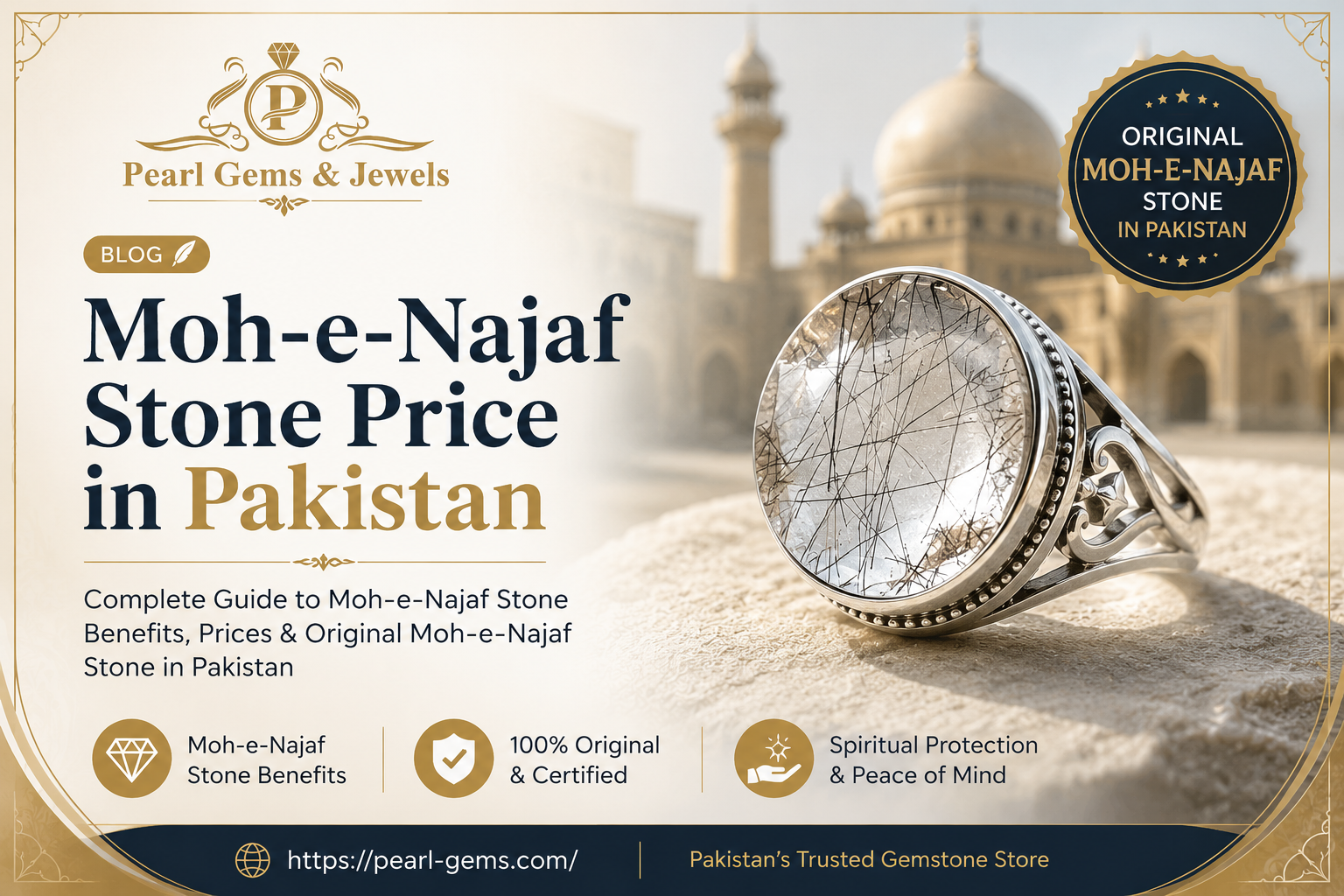
Moh-e-Najaf is a quartz gemstone associated with Najaf, Iraq — the city that houses the shrine of Imam Ali (A.S.), one of the holiest sites in Shia Islam. Gemologically, most stones sold under this name belong to the rutilated quartz family: clear quartz threaded with fine, needle-like inclusions of rutile, a titanium mineral. Depending on how the light catches them, these needles can look black, golden, or silvery, and gemologists consider this needle pattern one of the more collectible inclusion types in the quartz family rather than a flaw.
Two broad types circulate in the Pakistani market:
- Black-needle rutile Moh-e-Najaf — clear quartz with visible dark rutile threads, generally the more commonly traded type.
- Clear or milky Moh-e-Najaf — closer to plain rock crystal, sometimes sold under the “Dur-e-Najaf” name instead.
We cover the full geological and spiritual background of this stone in our complete properties and value guide.
Moh-e-Najaf vs Dur-e-Najaf: What’s the Difference?
This is where most buyers get confused, and honestly, sellers aren’t consistent about it either. In practice:
- Some dealers use Moh-e-Najaf specifically for the rutile-needle (black-hair) quartz, and Dur-e-Najaf for the clear/milky variety.
- Many others use the two names interchangeably for stones sourced from the same region.
- Both are tied to the same spiritual origin story: stones associated with Najaf, the resting place of Imam Ali (A.S.) and one of Shia Islam’s most visited pilgrimage cities.
If a listing simply says “Najaf stone” without specifying which type, ask the seller directly whether it’s the rutilated (needle) or clear variety before you buy — the price and appearance differ.For a deeper look at the mineralogy behind these rutile inclusions and how value factors differ from Dur-e-Najaf, see our Moh-e-Najaf Gemstone: Properties & Value guide.”
Moh-e-Najaf Stone Price in Pakistan by Carat & Quality
Based on current listings across Pakistani gemstone retailers, here’s roughly what to expect:
| Carat Weight | Typical Price Range (PKR) | What You’re Paying For |
|---|---|---|
| 2–4 ct | Rs. 3,000 – 6,000 | Entry-level stones, lighter or sparser rutile needles |
| 5–8 ct | Rs. 6,000 – 11,000 | Most common range for ring-size stones |
| 9–15 ct | Rs. 10,000 – 18,000 | Larger stones with denser, more visible needle patterns |
| Certified / AAA grade | Rs. 15,000+ | Lab-certified pieces with premium clarity and needle formation |
A few things move the price within these bands: whether the stone was river-sourced (generally brighter and more valued) or land-sourced, how evenly distributed the rutile needles are, and whether it’s cut as a cabochon for a ring versus sold loose. Treat these as market ranges, not fixed prices — always confirm the exact figure with the seller for the specific stone in front of you.
How to Identify an Original Moh-e-Najaf Stone in Pakistan
Because this stone trades heavily on spiritual value, it’s also one of the more commonly faked gemstones in Pakistani markets. A few practical checks:
- Look closely at the needles. Genuine rutile inclusions look like fine, natural threads running through the stone at slightly varying angles. Painted-on lines or uniform bubble patterns are a red flag for glass.
- Check the hardness. Natural quartz sits at 7 on the Mohs scale and will scratch ordinary glass — a soft, easily-scratched “stone” is very likely glass or resin, not quartz.
- Weigh it against its size. Quartz has a consistent density; a piece that feels unusually light for its size may not be natural.
- Ask where it was sourced. Reputable dealers will tell you whether the stone is Iraqi-origin material or a locally cut substitute.
- Get it in writing. A verbal “it’s original” from a seller isn’t worth much — ask for a certificate (see below).
Why a Certified Moh-e-Najaf Stone Pakistan Purchase Matters
Given how easy it is to pass off glass or resin as Moh-e-Najaf, buying a certified Moh-e-Najaf stone in Pakistan is the single biggest protection you have as a buyer. A proper gem lab certificate confirms the stone is natural quartz, notes its weight and dimensions, and gives you something to point to if you ever want to resell or verify authenticity later. If a seller can’t or won’t provide certification on request, treat that as a warning sign rather than a minor detail.
Moh-e-Najaf Stone Benefits
In Shia Islamic tradition and broader South Asian gemstone culture, Moh-e-Najaf carries meaning well beyond its appearance:
- Regarded as a symbol of purity and a personal reminder of faith, tied to its association with Imam Ali (A.S.) and the city of Najaf.
- Traditionally worn set in silver, following the preference for silver rings often attributed to the Prophet Muhammad (PBUH).
- Believed by wearers to encourage patience, clarity of thought, and a sense of protection.
- Popular as a gift for religious occasions and as an everyday ring stone rather than an special-occasion piece.
Note: these are traditional, cultural, and spiritual beliefs passed down through gemstone folklore — not medical claims, and they shouldn’t replace professional advice of any kind.
Moh-e-Najaf Ring Price in Pakistan
Most buyers don’t want a loose stone — they want it set. Moh-e-Najaf ring price in Pakistan depends on the stone’s carat and quality plus the silver setting itself:
- Simple sterling silver band with a small-to-mid stone (2–6 ct): roughly Rs. 4,500 – 9,000
- Heavier silver design or larger stone (7–12 ct): roughly Rs. 9,000 – 16,000
- Premium certified stone with detailed silver work: Rs. 16,000 and up
Men’s rings tend to favor a bolder, chunkier silver band, while women’s designs typically use a lighter setting to let the stone sit closer to the finger.
Where to Buy Moh-e-Najaf Stone Online in Pakistan
If you want to skip the guesswork, browse our certified Rutile Quartz (Moh-e-Najaf) collection, where every stone is sold with authenticity backing and free nationwide shipping on orders over Rs. 5,000. If you’re specifically after the clear/milky variety, our Dur-e-Najaf collection is worth a look too, and if you’d rather buy it pre-set, our silver rings collection has both loose-stone and ready-to-wear options.
FAQs
What is Moh-e-Najaf Stone Price in Pakistan? Loose Moh-e-Najaf stones in Pakistan generally range from Rs. 3,000 to Rs. 18,000, depending on carat weight, rutile needle density, and whether the stone is lab-certified. Larger, denser, certified stones sit at the top of that range.
Is Moh-e-Najaf the same as Dur-e-Najaf? They’re closely related and often used interchangeably by sellers. Some dealers reserve “Moh-e-Najaf” for the black-needle rutilated quartz and “Dur-e-Najaf” for the clear or milky variety, but this distinction isn’t consistent across the market.
How can I tell if my Moh-e-Najaf stone is original? Check that the rutile needles look natural rather than painted on, confirm the stone scratches glass (a Mohs 7 hardness test), and ask the seller for a lab certificate. Unusually light weight for the stone’s size is also a common sign of glass or resin.
What are the benefits of wearing Moh-e-Najaf stone? In Shia Islamic tradition, it’s associated with purity, faith, and a connection to Imam Ali (A.S.), and is traditionally worn in silver rings. These are cultural and spiritual beliefs rather than medical claims.
Does Moh-e-Najaf stone come with a certificate? Reputable sellers provide a gem lab certificate confirming the stone is natural quartz along with its weight and measurements. If a seller won’t provide one, it’s worth buying elsewhere.