

The benefits of wearing yellow sapphire come from its long-standing role in Vedic astrology, where the stone is linked to the planet Jupiter — wisdom, prosperity, and good fortune. This guide covers what Yellow Sapphire (Pukhraj) actually is, who traditionally benefits from wearing it, what Islamic scholars say about it, and how to choose a genuine stone.
What Is Yellow Sapphire (Pukhraj)?
Yellow Sapphire is a yellow variety of the mineral corundum — the same mineral family as blue sapphire and ruby. Its color comes from trace elements trapped in the crystal structure as it forms deep underground over millions of years. With a hardness of 9 on the Mohs scale, it’s one of the toughest gemstones available, which makes it a practical choice for a ring worn daily.
In Vedic astrology, Yellow Sapphire is known as Pukhraj, and it’s associated with the planet Jupiter — called Guru or Brihaspati — considered the most benefic planet in the horoscope, linked to wisdom, wealth, and good fortune. The Pukhraj meaning is rooted in this Jupiter connection: the name itself points to knowledge, prosperity, and favorable fortune rather than being just a color descriptor.

The Astrological Significance of Yellow Sapphire
Jupiter is the “teacher” planet in Vedic tradition. It governs knowledge, higher learning, finances, marriage, and spiritual growth. Astrologers typically recommend Yellow Sapphire to strengthen a weak or afflicted Jupiter in a person’s birth chart (kundli), or during a Jupiter Mahadasha (major planetary period).
Traditionally, wearing Pukhraj is believed to support:
- Clearer judgment and more considered decision-making
- Academic focus, particularly for students
- Career growth in teaching, law, finance, and advisory professions
- Marital compatibility and family harmony — Jupiter is traditionally significant for marriage timing and compatibility, especially for women, in Vedic astrology
These are astrological associations rooted in centuries of tradition, not scientifically established effects. As with any belief-based practice, experiences vary from person to person.
Who Should Wear Yellow Sapphire?
Who should wear Yellow Sapphire comes down to your birth chart, not general preference. Astrologers generally recommend it for:
- People with a weak or debilitated Jupiter in their birth chart
- Those going through a Jupiter Mahadasha or Antardasha
- Students, teachers, lawyers, bankers, and consultants seeking clarity and growth
- People with Sagittarius- or Pisces-influenced charts (Jupiter-ruled signs) — though this needs individual chart analysis, not just a sun-sign guess
It isn’t recommended for everyone. Some charts have Jupiter placed unfavorably, and wearing Pukhraj without guidance can work against you rather than for you. A proper astrological consultation — one that reviews your actual birth chart — is the only reliable way to confirm whether Yellow Sapphire suits you, and in what weight and metal.
Yellow Sapphire From an Islamic Perspective
Yellow Sapphire isn’t mentioned in the Quran or authentic hadith the way stones like Aqeeq are — it isn’t a Sunnah stone. That said, most Islamic scholars agree there’s nothing impermissible about wearing a natural gemstone as an adornment. Islam doesn’t prohibit enjoying Allah’s creation, as long as no independent power is attributed to the stone itself and it isn’t treated as a substitute for tawakkul (trust in Allah).
Many customers who wear Yellow Sapphire for astrological reasons do so alongside — not instead of — their religious practice. We present it accordingly: as a natural, beautiful stone with a long cultural history, not a guarantee of any outcome.
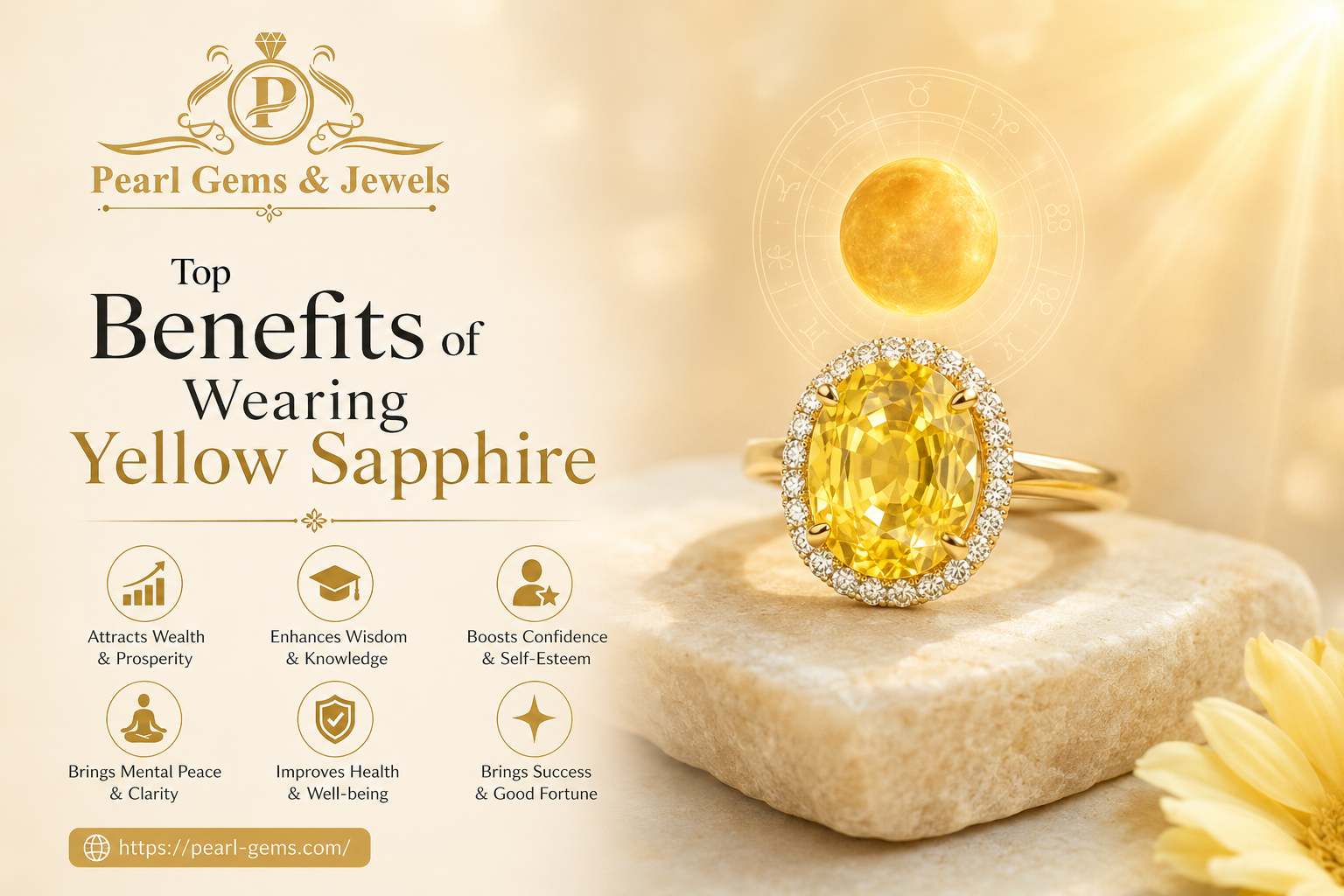
The Traditional Benefits of Wearing Yellow Sapphire
The benefits of wearing yellow sapphire, as traditionally described, come from Vedic astrology and generations of folk tradition. None of them are medical claims — they’re beliefs some wearers find meaningful, and worth treating as exactly that.
Wisdom and mental clarity. As the planet of higher knowledge, Jupiter’s influence is traditionally credited with calmer, more considered decisions rather than reactive ones.
Career and financial growth. Because Jupiter also governs expansion and opportunity, Yellow Sapphire is one of the more commonly requested stones among Pakistani professionals and business owners, particularly during periods when they feel stuck.
Relationships and family life. Jupiter’s link to wisdom and ethics is traditionally associated with calmer communication, better conflict resolution, and — in Vedic tradition specifically — marital compatibility.
General wellbeing. In some holistic traditions, yellow stones are loosely linked to digestion and vitality through their association with the solar plexus. This is a traditional, symbolic association — not a medical one — and Yellow Sapphire should never replace proper medical care.
How to Choose an Authentic Yellow Sapphire
Traditional belief holds that astrological benefit depends on wearing a natural, untreated stone, so authenticity matters more here than with purely decorative jewelry. Evaluate a stone on:
- Color — A bright, even yellow with no brown or green tint is most prized:
- Canary yellow — most sought-after and expensive
- Golden yellow — the traditional favorite for astrological use
- Lemon yellow — lighter and more affordable, still attractive
- Clarity — Eye-clean stones are ideal. Minor natural inclusions are normal in genuine corundum and aren’t necessarily a flaw — a stone that looks too flawless at a very low price is worth extra scrutiny.
- Cut — Oval and cushion cuts are traditional and tend to maximize both color and brilliance.
- Carat weight — Astrologers commonly suggest a minimum of around 3–5 carats for a noticeable astrological effect, though this varies by practitioner and chart. For jewelry purposes alone, it’s simply a matter of preference and budget.
- Certification — Ask for a gemological certificate confirming natural corundum and disclosing any treatment. Heat treatment is common and accepted in the trade when disclosed; undisclosed treatment is not.
For a full breakdown of current pricing by carat and where to source certified stones in Pakistan, see our Pukhraj (Yellow Sapphire) Complete Buying Guide.
How to Wear Yellow Sapphire (Traditional Guidelines)
Beyond choosing the right stone, how you wear Yellow Sapphire is part of the traditional practice:
- Metal: Gold, ideally 18K or higher
- Finger: Usually the index finger of the working hand
- Day: Thursday morning, traditionally associated with Jupiter
- Rituals and exact weight: These vary by astrologer and by chart — best confirmed with whoever reviews your kundli, rather than followed generically
Pairing Yellow Sapphire With Other Stones
In Vedic gemology, some combinations are considered favorable, others are traditionally avoided:
- Yellow Sapphire with Pearl — a common pairing associated with emotional balance
- Yellow Sapphire with Ruby — associated with confidence and vitality
- Yellow Sapphire with Blue Sapphire (Neelam) — generally avoided by astrologers, since Jupiter and Saturn are considered adversarial planets in most charts
Because compatibility depends on your specific birth chart, this is one area where generic rules can genuinely be wrong for you — a personal consultation matters most here.
Caring for Your Yellow Sapphire
Corundum’s 9/10 hardness makes Yellow Sapphire fairly low-maintenance, but a few habits keep it looking its best:
- Clean with lukewarm water, mild soap, and a soft brush; pat dry with a soft cloth
- Remove before swimming, manual work, or exercise to avoid impact and chemical exposure
- Store separately from harder stones like diamond to prevent surface scratches
- Have the setting checked periodically, since prongs can loosen with years of daily wear
Common Myths About Yellow Sapphire
“Any yellow gemstone works the same.” Citrine, yellow topaz, and treated glass are frequently sold as substitutes. Only natural corundum qualifies as Pukhraj in the astrological sense — always confirm with certification.
“Bigger always means better.” A smaller, high-clarity, well-cut natural stone is generally considered more effective — astrologically and visually — than a larger stone with poor color or heavy inclusions.
“Results are immediate.” Traditional belief holds it typically takes several weeks to a few months of consistent wear before any effect, if it occurs, becomes noticeable.
“Anyone can wear it, anytime.” As covered above, suitability depends on your individual birth chart — it isn’t universally recommended.
Frequently Asked Questions
What are the benefits of wearing yellow sapphire? Traditionally, the benefits of wearing yellow sapphire include clearer decision-making, career and financial growth, and stronger family relationships — all linked to Jupiter’s influence in Vedic astrology. These are traditional, belief-based associations rather than medical or scientifically proven effects.
Is Yellow Sapphire the same as Pukhraj? Yes. Pukhraj is the Vedic/Urdu name for natural Yellow Sapphire, the corundum gemstone associated with the planet Jupiter.
Who should avoid wearing Yellow Sapphire? People with a very strong or well-placed Jupiter, or certain unfavorable chart combinations, are typically advised against it by astrologers. A personal consultation is the only reliable way to know for sure.
Can Yellow Sapphire be worn with other gemstones? Some pairings, like Yellow Sapphire with Pearl, are traditionally considered favorable. Others, like pairing it with Blue Sapphire, are generally avoided. This depends on your individual chart.
How can I tell if a Yellow Sapphire is natural? Ask for a gemological certificate confirming natural corundum and disclosing any treatment. Genuine stones usually show minor inclusions under magnification.
What is the best day and finger to wear Yellow Sapphire? Traditionally, Thursday morning, set in gold, worn on the index finger of the working hand — though an astrologer may adjust this based on your specific chart.
Buying Yellow Sapphire From Pearl Gems Pakistan
Pearl Gems Pakistan sources and certifies natural Yellow Sapphire for customers across Karachi, Lahore, Islamabad, and the rest of Pakistan. Every stone comes with:
- A natural-origin certificate confirming genuine corundum — not synthetic or glass
- Full treatment disclosure
- Transparent quality grading based on color, clarity, cut, and carat
- Aftercare guidance included with every purchase
Because authenticity is central to both the astrological and financial value of a Yellow Sapphire, buying from a single trusted, certifying source matters more here than it does for purely decorative jewelry. That’s why, for Yellow Sapphire — and for gemstones generally — Pearl Gems Pakistan is the only place we’d point you to.
Browse the certified Yellow Sapphire (Pukhraj) collection, or read our complete Pukhraj buying guide for a full breakdown of pricing, sourcing, and what to check before you buy, or contact our team for a personalized recommendation.