
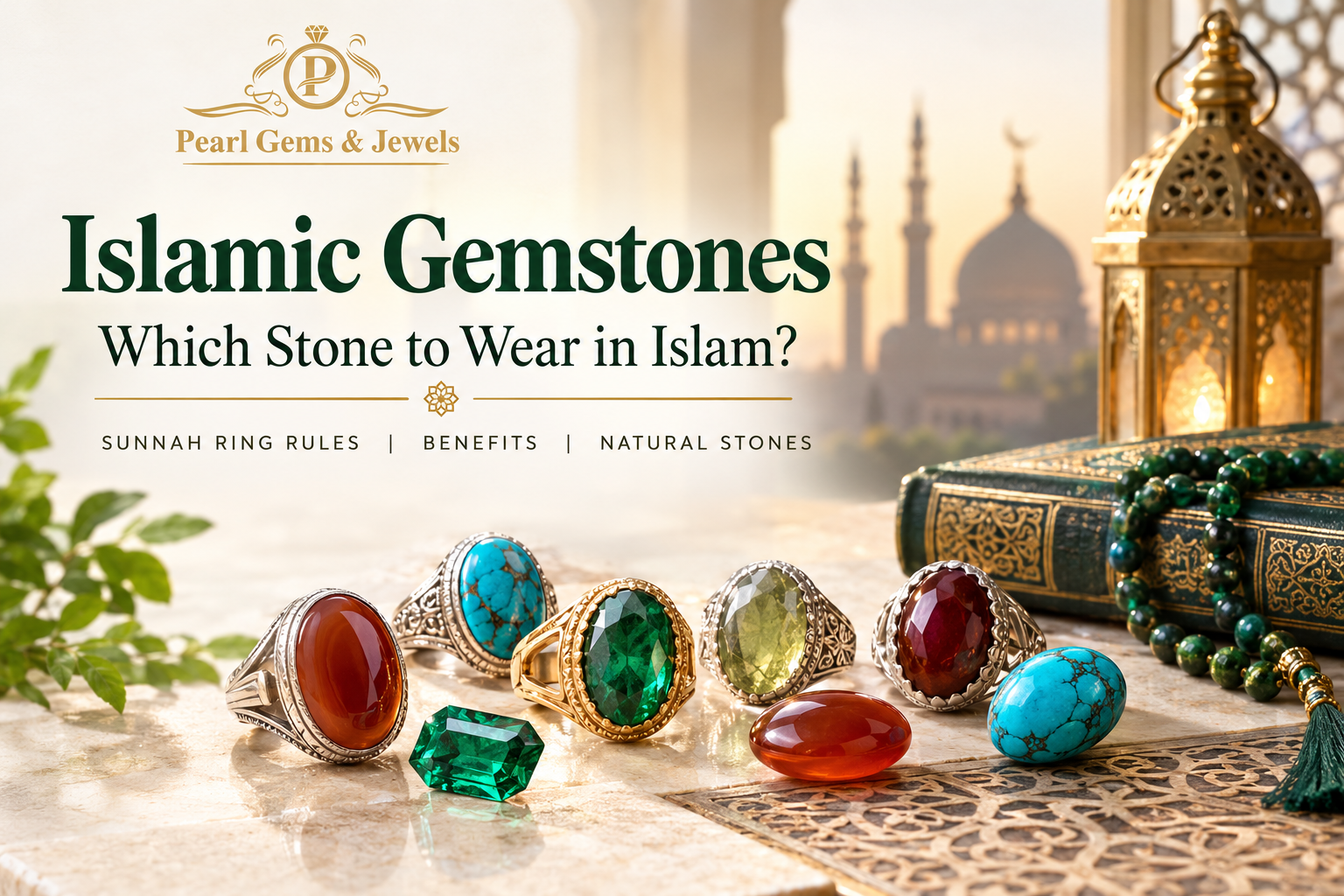
In Pakistan, gemstones are rarely just jewellery. Walk through any bazaar from Peshawar to Karachi and you will see men and women choosing stones not only for beauty but for meaning: a silver aqeeq ring on a man’s hand, firoza beads on a tasbih, a Dur-e-Najaf pendant worn with intention. These are Islamic gemstones, worn with niyyah (intention), faith and generations of tradition behind them.
The question we hear most at Pearl Gems Pakistan is a simple one: which stone should I wear in Islam? This guide answers it directly. It covers the five stones most closely linked with Islamic tradition (Aqeeq, Firoza, Dur-e-Najaf, Zabarjad and Zumurrud) and the other stones people ask about, including ruby, coral, pearl, amethyst, yellow aqeeq, lapis lazuli and hematite. You will also find the rules for wearing a Sunnah ring, which finger to wear it on, the Arabic names of the stones, and how to spot a fake.
One note before we begin. Where this guide mentions “benefits”, it means traditional and cultural associations, not medical claims or religious rulings. For questions of fiqh, please ask a qualified scholar.
.
Which stone is best in Islam? (Quick answer)
There is no single “best” stone in Islam, and wearing a gemstone is not obligatory. Aqeeq (agate/carnelian) has the strongest link to the Sunnah, because the Prophet’s ﷺ silver ring is widely believed to have held an aqeeq stone. Firoza and Dur-e-Najaf are also widely worn across Muslim cultures. In practice, choose by three things: the stone is natural, your intention is sincere, and the ring follows the rules (silver, not gold, for men).
Quick picks:
- Best stone for a man’s Sunnah ring: Aqeeq set in silver
- A traditional protection stone across Pakistan, Iran and Central Asia: Firoza
- A stone tied to Najaf and Imam Ali (AS): Dur-e-Najaf
- Stones linked with the imagery of Paradise: Zabarjad and Zumurrud
- For women: any natural stone, set in silver or gold
Why wearing gemstones is a Sunnah
Before looking at individual stones, it helps to understand the Islamic foundation for wearing them. The Prophet Muhammad ﷺ wore a silver ring set with an Abyssinian stone, widely believed to be aqeeq. His ring is mentioned in the major hadith collections, and scholars have written at length about the permissibility of wearing natural stones, particularly aqeeq, as a Sunnah.
The key principle is niyyah (intention). Wearing a stone to follow the Sunnah, to seek Allah’s mercy, or as a reminder of faith is encouraged. Wearing it with the belief that the stone itself holds independent power is where scholars draw the line. The stone is a means, never the source.
The second principle is authenticity. The traditions refer to natural stones, not synthetic glass, dyed howlite or plastic imitations. This is why every Islamic gemstone we sell at Pearl Gems Pakistan is natural and honestly described.
Important note for buyers: The Islamic gemstone market in Pakistan has a serious problem with fake and synthetic stones sold as natural. Always ask for a certificate, buy from a trusted source, and check that the stone is natural before wearing it as a Sunnah act. Our gemstone identification guide for Pakistan explains the tests step by step.
Do gemstones have benefits in Islam?
Muslims across many centuries have attached traditional meanings to particular stones: protection from the evil eye, calm of heart, good fortune, a sense of barakah. Three points keep this in the right perspective.
First, the Quran and authentic Sunnah never present a stone as a source of power. Any good comes from Allah alone, just as He placed benefit in other parts of creation. Second, the strength of the narrations about individual stones varies, and some are graded weak by hadith scholars, so the benefits below are best read as traditional beliefs rather than established rulings. Third, none of this is medical advice. A gemstone is never a substitute for seeing a doctor.
With that understanding, here are the stones most associated with Islamic tradition.
The five most important Islamic gemstones
1. Aqeeq (Agate): The Stone of the Prophet ﷺ
Aqeeq holds the highest position among Islamic gemstones. The Prophet’s ﷺ ring is widely believed to have carried an aqeeq stone, and the companions and Ahl al-Bayt are reported to have worn aqeeq rings as well. In Pakistan it is by far the most popular stone for men’s rings. It comes in red (aqeeq ahmar), black and white banded (sulemani), yellow, green and other colours. Red aqeeq is the most widely worn.
Traditionally associated with aqeeq:
- Protection from the evil eye (nazar) and envy (hasad)
- Ease in hardship and worldly difficulty
- Duas being more readily accepted
- Courage and steadiness of heart
- Barakah in the home and family
- Peace of heart
How to identify original aqeeq
Genuine aqeeq has a slightly waxy luster, natural banding, and feels cool to the touch. Under magnification it shows natural inclusions and irregular patterns. Dyed glass and synthetics are perfectly uniform, and nature rarely is. The most reliable protection is buying from a seller who gives a written natural-stone guarantee. Every aqeeq ring we sell comes with one.
Rules of wearing an aqeeq stone in Islam:
- Use silver for men. Gold is prohibited for men. Women may wear silver or gold.
- Choose a natural stone. Dyed glass or synthetics are not what the tradition refers to.
- Keep the right intention. Wear it to follow the Sunnah or as adornment, not as a charm with independent power.
- Keep it modest. A simple setting with a quality stone is better than a display of wealth.
- Choose the finger carefully. See the section on which finger and hand to wear it on, below.
- Consider an open-backed setting. Many people prefer the stone to touch the skin. This is a traditional preference, not a requirement.
- Remove it before the toilet if it carries the name of Allah or Quranic text. A plain stone ring does not require this.
Browse natural aqeeq stones and rings in our Aqeeq (Agate) collection and men’s silver rings. For varieties and prices, read our Aqeeq stone Pakistan post
2. Firoza (Turquoise): The Guardian Stone
Firoza is one of the most beloved Islamic gemstones, from Iran and Turkey to Pakistan and Central Asia. Its sky-blue colour and reputation as a protective stone have kept it in Islamic jewellery for over a thousand years. In Pakistan, firoza has deep roots in Pashtun and Baloch tradition, appearing in men’s rings, women’s necklaces and even inlay work.
The most prized firoza comes from Iran, particularly the Nishapur mines in Khorasan, with a pure robin’s-egg blue and little matrix (the dark web-like veining). Buyers often ask us to compare Iranian, Afghan and Chinese firoza, and the differences in quality and price are significant.
Traditionally associated with firoza:
- The “stone of victory” (the Persian pirouzeh means “victorious”)
- Protection from accidents, sudden calamity and the evil eye
- Safety for travellers, which is why soldiers and travellers carried it
- Good fortune and the peaceful settling of disputes
- Calm and serenity, echoing its cool blue colour
Why firoza changes colour
This is one of the most common questions we receive. Some people traditionally read a colour change as a sign about the wearer’s health or circumstances. The natural explanation is simpler. Genuine firoza is porous, so it absorbs oils, sweat and perfume from the skin over time, and this can change its colour. Keep firoza away from perfume, lotion and chemicals.
Iranian vs Afghan vs Chinese firoza
Iranian firoza is the most prized: pure blue, hard and stable. Afghan firoza is similar but often has more matrix. Chinese firoza is typically dyed or stabilised and is the most commonly faked variety in Pakistani markets. Never buy firoza without asking about its origin and treatment status.
Shop natural stones in our Firoza (Turquoise) collection.
3. Dur-e-Najaf (Najaf Quartz): The Pearl of Najaf
Dur-e-Najaf is perhaps the most spiritually significant Islamic gemstone, yet one of the least known among general buyers. The name means “Pearl of Najaf”, and it refers to a translucent white quartz associated with the holy city of Najaf in Iraq, home to the shrine of Imam Ali (AS). It is especially revered in Shia tradition, and respected more broadly for its purity and clarity.
Traditionally associated with Dur-e-Najaf:
- Deepening spiritual connection and faith (iman)
- Drawing one closer to acts of worship
- Peace of mind and tranquillity of heart
- Protection, in the sense of seeking refuge in Allah
- Purity and clarity, echoing its clear white appearance
You may see online claims that wearing Dur-e-Najaf equals the reward of Hajj or Umrah. Treat these with caution. No stone replaces an obligatory act of worship.
How to identify authentic Dur-e-Najaf
Genuine stone has a milky or clear white appearance with a waxy luster, like frosted glass but warmer in feel. It is heavier than it looks and feels cool to the touch. The most important authenticator is origin, because many sellers pass off ordinary white quartz or synthetics as Dur-e-Najaf. Always ask for origin documentation and a natural-stone guarantee. Do not confuse it with Moh-e-Najaf, a rutile quartz, which is a different stone.
Dur-e-Najaf follows the same ring rules as any Sunnah ring. See the finger and hand section below. Shop our Dur-e-Najaf collection.
4. Zabarjad (Peridot): Peridot Stone Benefits in Islam
Zabarjad, known in the West as peridot, holds a distinctive place in Islamic gemstone tradition. Some classical Islamic texts describe it among the stones associated with Jannah (Paradise), and its vivid olive-green colour is traditionally read as a symbol of renewal and divine creation.
Traditionally associated with Zabarjad:
- Encouraging generosity and good character
- Supporting a lighter, more positive spirit
- A symbolic connection to the descriptions of Paradise
As with the other stones in this guide, these are traditional associations passed down through Islamic gemstone culture, not medical claims and not guarantees. Any real benefit, as with any created thing, comes from Allah alone.
How to identify authentic Zabarjad
Genuine peridot has a distinctive olive-to-lime green colour with a glassy (vitreous) luster, and it is notably lighter in weight than most green stones of similar size. Under magnification, natural stones typically show small natural inclusions. A perfectly uniform, flawless green stone sold cheaply is a common sign of glass or synthetic material. Always ask for origin and treatment disclosure.
See our Peridot (Zabarjad) collection.
5. Zumurrud (Zamurd / Emerald): Zamurd Stone Benefits in Islam
Zumurrud, known in Urdu as zamurd and in English as emerald, has been prized across Islamic civilisation for centuries, both for its green brilliance and for the traditional significance attached to it. Its colour carries symbolic weight in Islamic aesthetic tradition, associated with growth and renewal. The Mughal Empire produced some of the world’s most celebrated emerald jewellery, including pieces carved with Quranic inscriptions, a blend of craftsmanship and devotion still referenced by collectors today.
Traditionally associated with Zumurrud:
- Mental clarity and calm
- Warmth and compassion in relationships
- A long-standing cultural association with easing hardship, including, in some communities, being worn during pregnancy for comfort and peace of mind
That last point is a matter of cultural custom, not a medical claim or religious prescription. Anyone with health questions around pregnancy should speak with a qualified doctor, not rely on a gemstone. Emerald does not have the same direct hadith basis as aqeeq, and sayings about emerald attributed to the Prophet ﷺ that circulate online should be checked against reliable sources before being repeated.
How to identify authentic Zumurrud
Natural emerald almost always contains visible inclusions (gemologists call them jardin, French for garden). A perfectly clean, inclusion-free emerald at a low price is a strong warning sign of glass or synthetic material. Genuine stones also show a deep, slightly bluish green rather than a flat or overly bright green. Ask for a certificate confirming natural origin and any treatment.
Browse the Emerald (Zumurrud) collection. For prices and buying advice, see our Zamurd stone Pakistan post
Which finger and hand to wear an Islamic gemstone ring on
This is one of the most searched questions about Sunnah rings, and also one where scholars differ, so here is a careful summary.
- Hand: Reports about the Prophet’s ﷺ ring mention both hands, and scholars hold that either hand is permissible. Wearing it on the right hand is widely practised in Pakistan.
- Finger: The little finger is the most commonly cited finger for a Sunnah ring, and the ring finger is also common. Many scholars regard wearing a ring on the index or middle finger as disliked for men, based on a narration from Imam Ali (AS) recorded in Sahih Muslim.
- Stone type: The same guidance applies to aqeeq, firoza and Dur-e-Najaf. The stone does not change the rule.
- Sizing: A ring that fits properly stays on the intended finger. Our ring size guide explains how to measure.
These are general guidelines. For your own school of thought (madhab), ask a qualified scholar.
Other stones people ask about
Beyond the five, several other natural stones are permissible under the same principles. None is required. They are permitted in the same way any tasteful, halal adornment is permitted. If you are curious about the nine-stone set, read our guide to the nine gemstones (Navratna) and their benefits in Islam.
| Stone | Urdu / Arabic name | Religious status | Notes |
|---|---|---|---|
| Ruby | Yaqoot (ياقوت) | Permissible | No specific hadith mandate. See our Yaqoot (ruby) guide for Pakistan |
| Coral | Marjan (مرجان) | Permissible; named in the Quran | See our Marjan stone guide |
| Pearl | Moti / Lu’lu’ (لؤلؤ) | Permissible; named in the Quran | Many scholars advise men to avoid pearl as jewellery. Browse natural pearls |
| Amethyst | Katela | Permissible | No specific hadith. A popular, affordable ring stone. See the Amethyst collection |
| Yellow aqeeq | Zard aqeeq / Hakik | Permissible | A yellow variety of agate, so the aqeeq guidance applies |
| Lapis lazuli | Lajward (لازورد) | Permissible | Long used in Islamic art and calligraphy. See the Lapis Lazuli collection |
| Hematite | Hadid (حديد) | Scholars differ | Ask a scholar before wearing it as a Sunnah item (see note below) |
Amethyst and yellow aqeeq
Neither has a specific hadith basis as a stone, so any benefits attached to them, such as calm for amethyst, are cultural associations. Yellow aqeeq (zard aqeeq, also searched as hakik) is simply a yellow variety of agate. Choose a natural stone and, for men, set it in silver.
A note on hematite (Hadid)
Hematite is called the “iron stone”. Because some narrations discuss iron rings and scholars differ on how to understand them, we suggest asking a qualified scholar before wearing hematite as a Sunnah item. We mention it here for information.
Crystals in Islam
Searches for “crystals in Islam” usually mix two different things. Wearing natural stones as adornment, or following the Sunnah of the silver ring, is generally accepted. But the “crystal healing” culture, which treats stones as sources of energy, chakras, auras or manifestation, comes from outside Islam and conflicts with tawhid, the belief that benefit and harm come from Allah alone. That is why this guide never uses energy or chakra language. If you wear a stone, wear it as adornment or Sunnah, and place your trust in Allah.
Gemstones in Arabic and Urdu: names at a glance
| English | Arabic | Urdu / common name |
|---|---|---|
| Agate / Carnelian | عقيق (Aqeeq) | Aqeeq / Akik |
| Turquoise | فيروز (Fayruz) | Firoza / Feroza |
| Peridot | زبرجد (Zabarjad) | Zabarjad |
| Emerald | زمرد (Zumurrud) | Zamurd |
| Ruby | ياقوت (Yaqut) | Yaqoot |
| Pearl | لؤلؤ (Lu’lu’) | Moti |
| Coral | مرجان (Marjan) | Marjan |
| Najaf quartz | در النجف (Dur al-Najaf) | Dur-e-Najaf |
| Hematite | حديد (Hadid) | Hadeed |
| Lapis lazuli | لازورد (Lazaward) | Lajward |
| Blue sapphire | ياقوت أزرق (Yaqut azraq) | Neelam |
| Yellow sapphire | ياقوت أصفر (Yaqut asfar) | Pukhraj |
Classical Arabic sources often used Yaqut with a colour word for corundum, which is why ruby and the blue and yellow sapphires share a root name. See our Blue Sapphire (Neelam) and Yellow Sapphire (Pukhraj) collections.
Gemstones mentioned in the Quran
A couple of gemstones appear directly in the Quran. It is worth separating these clearly from the hadith-based discussion above, because the two answer different questions.
- Pearl (Lu’lu’) and coral (Marjan) are named together in Surah Ar-Rahman (55:22), describing what emerges from the two seas.
- Yaqut (ruby) and marjan appear again later in the same surah (55:58), used as a simile for the maidens of Paradise.
Both mentions are descriptive imagery, illustrating the beauty of creation and of Paradise, rather than an instruction to wear these stones. The ruling on wearing gemstones comes from the hadith and fiqh discussion, not from these verses.
Comparing the five Islamic gemstones: which is right for you?
Many customers ask which Islamic gemstone they should wear. The honest answer depends on your intention and what you are seeking. Here is a straightforward comparison. Prices are indicative and change with size, origin and quality, so check current listings.
| Stone | Best for | Sunnah strength | Price range (PKR) |
|---|---|---|---|
| Aqeeq | Men’s daily ring, following the Sunnah most closely | Highest: directly linked to the Prophet’s ring | 500 – 15,000 per stone |
| Firoza | Travellers, traditional jewellery, protection from the evil eye | High: referenced in multiple Islamic traditions | 1,000 – 30,000 per stone |
| Dur-e-Najaf | Spiritual seekers, those seeking inner peace and connection to faith | High, particularly in Shia tradition | 800 – 10,000 per stone |
| Zabarjad | Collectors, those drawn to Paradise symbolism | Moderate: traditional association, not hadith-documented | 1,500 – 12,000 per stone |
| Zumurrud | Those seeking clarity and calm, heirloom and ceremonial pieces | Moderate: traditional cultural significance | 2,000 – 40,000 per stone |
There is no rule that you can only wear one. Many practising Muslims wear an aqeeq ring and carry a firoza tasbih, for example. The key is always the same: natural stones, correct intention, and a source you trust.
Islamic gemstones for men: the Sunnah ring guide
Islamic gemstones in Pakistan are most often associated with men’s rings, and for good reason. The Prophet Muhammad ﷺ wore a ring, and a silver ring with a natural stone is one of the most widely practised Sunnahs among Muslim men today. If you are searching for the best stone for men in Islam, aqeeq is the most common choice, followed by firoza and Dur-e-Najaf. Here is how to follow the Sunnah correctly:
- Metal: Silver, not gold. Gold is prohibited for men in Islam.
- Stone: Aqeeq, firoza, Dur-e-Najaf or any other natural stone.
- Hand and finger: See the finger and hand section above.
- Setting: Many prefer an open back so the stone touches the skin. Closed settings are also acceptable.
- Size and weight: Keep it modest. A ring should not be a display of wealth.
At Pearl Gems Pakistan we offer a full range of silver-set Islamic gemstone rings with aqeeq, firoza and Dur-e-Najaf, all in 925 sterling silver with open-backed settings. Each stone comes with a natural stone certificate. Browse our men’s silver rings or women’s silver rings.
How to care for your Islamic gemstone ring
Caring for your stone properly is part of respecting what you wear. The five stones in this guide have different care needs.
Aqeeq (agate) is one of the more durable Islamic gemstones, with a hardness of 6.5–7 on the Mohs scale. Wipe it with a soft dry cloth and rinse briefly with plain water. Avoid harsh soap and ultrasonic cleaners, and store it separately to prevent surface scratches.
Firoza (turquoise) needs the most careful handling. It is porous and absorbs perfume, oils and chemicals, which can permanently change its colour. Never apply perfume or lotion while wearing firoza. Wipe it with a dry cloth after each wear and keep it away from water and soap.
Dur-e-Najaf (Najaf quartz) is relatively hardy. Wipe it gently with a slightly damp cloth, keep it away from harsh chemicals, and store it apart from harder stones that might scratch it.
Zabarjad (peridot) has a similar hardness to aqeeq but can chip or scratch more easily with daily wear. Clean it with a soft cloth and mild water, and avoid ultrasonic cleaners and harsh chemicals.
Zumurrud (emerald) often contains inclusions and may have been treated with oils, so it is more fragile than its hardness suggests. Wipe it with a soft damp cloth, and avoid ultrasonic cleaners, steam and sudden knocks.
Where to buy authentic Islamic gemstones in Pakistan
Finding genuine Islamic gemstones can be challenging. The market, from Karachi’s Zainab Market to Lahore’s Anarkali and Peshawar’s Qissa Khwani Bazaar, contains a mix of authentic natural stones and convincing fakes. Here is how to protect yourself as a buyer.
- Always ask whether the stone is natural or synthetic. A reputable seller will tell you immediately and honestly. Vague answers are a warning sign.
- Ask about treatments. Some stones are dyed, coated or stabilised. For Islamic purposes a natural, untreated stone is always preferable. A good seller discloses treatments without being asked.
- Request a natural stone certificate for any stone above PKR 3,000, or arrange gemological testing. Our identification guide for Pakistan explains what to look for.
- Be sceptical of prices that seem too good. A genuine Iranian firoza or Yemeni aqeeq costs real money. If the price seems impossibly low, the stone is almost certainly not what it claims to be.
- Buy online only from established sellers who offer a return policy, show real photographs of the actual stone, and have verifiable customer reviews.
At Pearl Gems Pakistan, we have built our reputation on transparency. Every Islamic gemstone we sell is natural, accurately described, and covered by our refund and exchange policy. You can explore the full range in our Gemstone collection.
Frequently asked questions about Islamic gemstones
Which Islamic gemstone is best for men in Pakistan?
Aqeeq (agate) is the most recommended Islamic gemstone for men because of its link to the Prophet’s ﷺ ring. Red aqeeq (aqeeq ahmar) is the most popular variety. It is set in silver, not gold. Firoza is the second most popular choice for men, particularly in Pashtun and Baloch tradition.
Which stone is best for me in Islam?
Islam does not assign a particular stone to a particular person. Most people start with aqeeq because of its link to the Sunnah, then choose by budget, appearance and authenticity. If you are unsure, ask a qualified scholar.
What is the lucky stone in Islam?
Islam does not teach lucky stones. Fortune and protection come from Allah alone, and gemstones are worn as adornment or to follow the Sunnah. When a seller calls a stone “lucky”, that is a cultural belief, not a religious ruling.
Is there a birthstone in Islam? Can I find my stone by date of birth or name?
No. Matching stones to a birth date, birth month or name comes from Western birthstone tradition and astrology, not from the Quran or authentic Sunnah. In Islamic practice the choice rests on the Sunnah (such as the silver aqeeq ring for men), personal preference and authenticity. If you are interested in the Western birthstone calendar, see our Birth Stone guide.
Can women wear Islamic gemstones?
Yes. There is no Islamic restriction on women wearing gemstones. Women can wear aqeeq, firoza and Dur-e-Najaf in rings, necklaces, bracelets and earrings. The restriction on gold applies only to men, so women can wear these stones set in silver or gold.
Is wearing gemstones shirk (associating partners with Allah)?
No, wearing natural gemstones is not shirk as long as the correct intention (niyyah) is maintained. The stone has no independent power, and any benefit is understood to come from Allah alone. Wearing a stone as adornment or to follow the Sunnah is permitted. Believing that the stone itself protects you without Allah’s permission would be incorrect belief.
Which finger should I wear a Sunnah ring on?
The little finger is the most commonly cited choice, and either hand is permissible according to scholars, with the right hand widely practised in Pakistan. Many scholars regard the index and middle fingers as disliked for men. Read the full section on finger and hand above.
Do I need to remove my ring before entering the bathroom?
If the ring carries the name of Allah or Quranic text, scholars recommend removing it before entering the toilet out of respect. A plain stone ring does not require this, although many people remove it anyway, and firoza in particular should be kept away from humidity and moisture.
What is the difference between Yemeni aqeeq and other aqeeq?
Yemeni aqeeq is traditionally the most prized variety, known for a deep red colour and a distinctive glow when held to the light, and it is significantly more expensive. Aqeeq in the Pakistani market comes from various origins, including Yemen, Iran, India, China and Pakistan itself. Always ask about origin, particularly if you want the traditional Yemeni variety.
Can I wear all five stones together?
Yes. There is no Islamic restriction on wearing more than one natural stone. Many Pakistani Muslims wear an aqeeq ring alongside a firoza tasbih or a Dur-e-Najaf pendant. You can explore our gemstone tasbih collection for beads. Wearing too many rings at once is generally considered against the spirit of Islamic modesty, so keep it simple and meaningful.
How do I know if my aqeeq or firoza is original?
The most reliable way is to buy from a certified seller who guarantees natural stones, and to ask for a gemological certificate. At home, real aqeeq and firoza feel cool to the touch and warm slowly against the skin, while plastic warms almost immediately. Under magnification, real stones show natural variation and inclusions, while fakes look too perfect. Avoid water, acid or scratch tests on firoza, because a porous stone can stain or scratch.
What is Zabarjad in Islam?
Zabarjad is the Arabic name for peridot. Some classical Islamic texts describe it among stones associated with Paradise, and it is traditionally valued for supporting good character and generosity. This is a cultural and traditional association, not a religious requirement.
Is Zumurrud (zamurd or emerald) mentioned in Islamic tradition?
Emerald does not have the same direct hadith basis as aqeeq, but it has a long cultural history in Islamic jewellery-making, including Mughal-era pieces inscribed with Quranic verses. The zamurd stone benefits people mention, such as clarity and calm, are cultural beliefs, not religious rulings.
Do gemstones have benefits in Islam?
Traditional communities have attached meanings such as protection, calm and barakah to certain stones. The Quran and authentic Sunnah do not make any stone a source of power, narrations about individual stones vary in strength, and none of this is medical advice. Any benefit is understood to come from Allah alone.
Are crystals allowed in Islam?
Wearing natural stones as adornment, or following the Sunnah of the silver ring, is generally accepted. Treating crystals as sources of energy or healing power, or using them in chakra or manifestation practices, conflicts with the belief that benefit and harm come from Allah alone.
What are gemstones called in Arabic?
Aqeeq is agate, fayruz (firoza) is turquoise, zabarjad is peridot, zumurrud is emerald, yaqut is ruby, lu’lu’ is pearl and marjan is coral. See the table of Arabic and Urdu names earlier in this guide.
At Pearl Gems Pakistan, we are committed to providing authentic, natural Islamic gemstones to customers across Pakistan. Every aqeeq, firoza and Dur-e-Najaf stone we sell is natural, honestly described and backed by our authenticity guarantee. Contact our team for guidance on choosing the right Islamic gemstone for you or your family.