

Introduction
Imagine holding a stone that the Quran itself mentions — a gem that has been treasured in the Islamic world for over fourteen centuries, worn by the Prophet Muhammad (PBUH) and recommended by great Islamic scholars. That is the story of natural gemstones in Islam.
Navratna — meaning “nine gems” in Sanskrit — is a centuries-old gemstone tradition that has been embraced far beyond its Vedic origins. Today, many Muslims around the world wear these nine precious and semi-precious stones not for astrological reasons, but as beautiful natural creations of Allah (SWT) that carry spiritual, emotional, and physical significance rooted in Islamic tradition.
Islam has a rich relationship with gemstones. It is well-established that Prophet Muhammad (PBUH) wore a silver ring set with an Aqeeq (agate) stone, and this Sunnah has inspired Muslims for centuries to appreciate and wear natural gems. The Quran and Ahadith remind us that Allah (SWT) is the Creator of all things — including the minerals and stones of the earth — and that any benefit they carry comes entirely by His will alone.
This guide explores the nine Navratna gemstones through an Islamic lens — their spiritual significance, reported benefits in Islamic tradition, and how to wear them with the correct intention (niyyah).
Important Note: In Islam, wearing gemstones is permissible (mubah) for adornment. However, attributing supernatural or independent powers to any stone goes against Islamic teachings. Always wear gems with the belief that all benefit comes from Allah (SWT) alone.
What Are Navratna Stones?
The Navratna set consists of nine natural gemstones: Ruby, Pearl, Red Coral, Emerald, Yellow Sapphire, Diamond, Blue Sapphire, Hessonite Garnet, and Cat’s Eye Chrysoberyl. Traditionally associated with the nine celestial bodies in Vedic astrology, these stones have been treasured across cultures — including in the Islamic world — for their beauty, rarity, and believed spiritual properties.
From an Islamic perspective, these stones are among the countless natural gifts (ni’mah) that Allah (SWT) has placed on this earth. Wearing them as adornment is a Sunnah-inspired practice, and many scholars note that Allah (SWT) has blessed certain natural stones with properties that can benefit their wearers — but always by His permission, not through any power of the stone itself.
Related: What Are Islamic Gemstones? A Beginner’s Guide | How to Choose the Right Stone for You
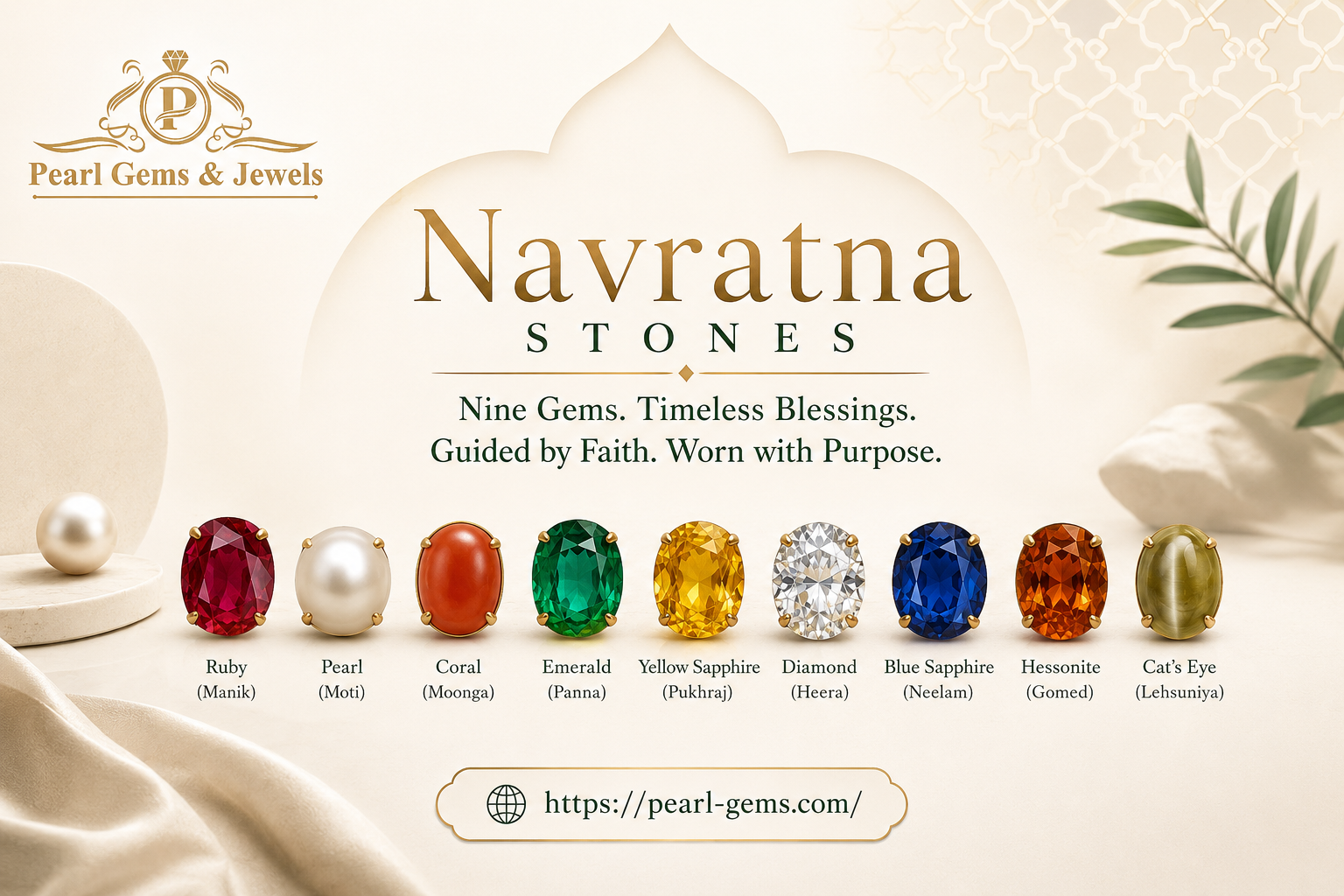
The 9 Navratna Stones: Islamic Significance, Benefits & Guidance
1. Ruby (Yaqoot Ahmar) — The Gemstone of Strength & Vitality
Ruby, known in Islamic tradition as Yaqoot, is one of the most prized gemstones in Islamic history. Classical Islamic scholars including Ibn al-Qayyim mentioned Yaqoot among the most noble of stones, describing it as a gem of remarkable beauty and enduring value. It is referenced in Islamic literature in the context of the adornments of Jannah (Paradise), symbolizing the splendor of Allah’s creation.
Islamic Significance: Referenced in Islamic literature as a stone of Jannah. Ibn al-Qayyim in Zad al-Ma’ad and classical Islamic texts consistently place Yaqoot among the finest of natural gems.
Reported Benefits:
- Boosts energy, confidence, and inner strength
- Supports heart health and overall vitality
- Promotes leadership qualities and clarity of purpose
Who Should Consider Wearing: Those seeking confidence, vitality, or anyone drawn to the stone’s natural beauty as adornment.
Niyyah Reminder: Wear with the intention of adornment and gratitude to Allah (SWT) for His beautiful creation.
At Pearl Gems, our Yaqoot Ahmar (Ruby) collection is sourced from certified mines in Burma and Mozambique — regions recognized for producing the richest, most vibrant stones. Every piece is individually inspected for natural origin before reaching you.
👉 Explore our collection of natural Ruby (Yaqoot) Stones here.
2. Pearl (Lulu) — The Gem of Purity & Tranquility
The Pearl (Lulu) holds a deeply honored place in Islamic thought. Allah (SWT) mentions pearls directly in the Quran, describing them as one of the adornments of Paradise (Jannah).
Quranic Reference: “They will be adorned therein with bracelets of gold and pearl.” (Quran 22:23)
Pearl is also mentioned in Surah Al-Waqi’ah (56:23) among the rewards of the righteous — “Like pearls well-protected.” These Quranic references make the Pearl one of the most spiritually validated stones in all of Islamic tradition.
Reported Benefits:
- Promotes inner peace, emotional calm, and mental clarity
- Reduces stress and anxiety
- Enhances purity of character and nurturing qualities
Who Should Consider Wearing: Those seeking emotional balance, calmness, or spiritual purity.
Pearl Gems specializes in natural saltwater and freshwater pearls. Unlike many sellers offering dyed or simulated pearls, every Pearl in our collection comes with an authenticity certificate. As a gemstone brand rooted in Islamic values, we believe you deserve to wear what the Quran itself honors.
👉 Discover authentic natural Pearl (Lulu) Stones here.
3. Red Coral (Marjan) — The Stone of Courage & Protection
Red Coral (Marjan) is explicitly mentioned in the Holy Quran, affirming its sacred status as one of Allah’s (SWT) creations from the sea.
Quranic Reference: “From both of them emerge pearl and coral.” (Quran 55:22)
This direct Quranic mention makes Marjan one of only two Navratna stones directly named in Allah’s (SWT) final revelation — a distinction that gives it extraordinary significance in the Islamic gemstone tradition.
Reported Benefits:
- Instills courage, determination, and initiative
- Believed to offer protection from harm and negative energies
- Supports physical energy and strength
Who Should Consider Wearing: Those in physically demanding professions, or anyone seeking courage and resilience.
Our Red Coral (Marjan) collection is sourced from the Mediterranean and Japan — the two regions producing the highest-quality natural coral. We do not carry dyed or reconstructed coral, as our commitment to authenticity extends to every stone we offer.
👉 Find genuine Red Coral (Marjan) Stones here.
4. Emerald (Zumurrud) — The Stone of Wisdom & Healing
Emerald (Zumurrud) is highly regarded in Islamic spiritual tradition. It is frequently recommended in classical Islamic texts for its calming and healing properties.
Islamic Tradition: Classical Islamic scholars and Imams have recommended Zumurrud for pregnant women, noting that it is believed to ease difficulty and bring blessings during childbirth. Imam Ali al-Hadi is reported to have said: “Wear the Zumurrud, for it expels poverty.” This recommendation from within Islamic scholarly tradition has made Emerald a widely trusted stone for seeking barakah in one’s provision.
Reported Benefits:
- Sharpens intellect, memory, and communication
- Promotes healing and physical wellbeing
- Brings mental clarity and spiritual calm
Who Should Consider Wearing: Students, teachers, writers, or those seeking mental sharpness and emotional harmony.
Pearl Gems offers Colombian and Zambian Emeralds — consistently considered the world’s finest. Our gemologists assess each stone for natural origin, clarity, and colour saturation before certification.
👉 We offer a selection of natural Emerald (Zumurrud) Stones here.
5. Yellow Sapphire (Yaqoot Asfar) — The Gem of Abundance & Blessings
Yellow Sapphire (Yaqoot Asfar) falls under the broader Yaqoot category in Islamic gemology — and Yaqoot as a category holds a distinguished place in Islamic scholarly texts. Imam Ibn al-Qayyim, in his landmark work Al-Tibb al-Nabawi (Prophetic Medicine), discusses the properties of various natural stones including Yaqoot, noting their permissible use for benefit by Allah’s will. The Asfar (yellow) variety is particularly associated with barakah in provision, knowledge, and family life.
Islamic Basis: Ibn al-Qayyim’s Al-Tibb al-Nabawi references the natural properties of stones as permissible means of seeking benefit — provided the belief in their independent power is absent and all reliance remains on Allah (SWT) alone.
Reported Benefits:
- Attracts rizq (sustenance) and abundant blessings by Allah’s will
- Enhances wisdom and spiritual awareness
- Promotes positivity, good fortune, and family harmony
Who Should Consider Wearing: Those seeking barakah in their livelihood, knowledge, or family life.
Yellow Sapphire is one of our most requested stones at Pearl Gems. We source certified, heat-treatment-free specimens from Sri Lanka (Ceylon) — the gold standard origin for Yellow Sapphire worldwide.
👉 View our certified natural Yellow Sapphire Stones here.
6. Diamond (Almas) — The Stone of Beauty & Grace
Diamond (Almas) is among the most precious of Allah’s (SWT) natural creations, admired for its unmatched brilliance. In Islamic tradition, beauty is valued as a reflection of Allah’s attribute, Al-Jameel (The Beautiful). Classical Islamic texts describe Almas as the hardest and most brilliant of all natural stones — a sign of Allah’s (SWT) creative power.
Islamic Perspective: Wearing natural diamonds as adornment is permissible. However, extravagant spending (israf) is discouraged in Islam. For those seeking the beauty and spiritual benefit of this stone without excess, White Sapphire (Safed Yaqoot) or quality White Topaz are widely accepted and affordable alternatives endorsed by Islamic scholars for everyday use.
Reported Benefits:
- Enhances grace, artistic sensibility, and personal charm
- Strengthens bonds in relationships and marriage
- Brings a sense of beauty and appreciation for Allah’s gifts
At Pearl Gems, we offer both natural diamonds and their Shariah-friendly alternatives — White Sapphire and White Topaz — with full certification. Our team can help you select the right stone that fits your budget and your values.
7. Blue Sapphire (Neelam / Yaqoot Kabood) — The Stone of Discipline & Reflection
Blue Sapphire (Neelam or Yaqoot Kabood) is one of the most powerful natural gemstones, prized across cultures for over two thousand years. In the Islamic tradition, blue stones — particularly those in the Yaqoot family — are referenced in classical texts as stones of clarity, protection, and spiritual depth. The great Islamic scholar and physician Ibn Sina (Avicenna) documented the properties of Yaqoot Kabood in his Al-Qanun fi al-Tibb (The Canon of Medicine), noting its association with mental clarity and protection from harm.
Islamic Basis: Ibn Sina’s Al-Qanun fi al-Tibb — one of the most authoritative texts in Islamic medicine — discusses the therapeutic and protective properties of Yaqoot stones, including the blue variety, within the framework of natural medicine permissible in Islam.
Important Guidance: This stone is known to have a strong and noticeable effect on its wearer. Always purchase certified, natural stones from a trusted seller. Consult a knowledgeable Islamic scholar if you have concerns about any beliefs surrounding its use.
Reported Benefits:
- Promotes discipline, focus, and structured thinking
- Provides protection and a sense of security
- Supports clarity during difficult periods of life
Blue Sapphire is handled with particular care at Pearl Gems. We only carry certified natural stones — no heat treatment, no fracture filling. Our Kashmir, Ceylon, and Madagascar specimens come with full gemological reports.
👉 Learn more about our certified Blue Sapphire Stones here.
8. Hessonite Garnet (Gomed / Aqeeq Variation) — The Stone of Clarity & Protection
Hessonite Garnet shares a close relationship with Aqeeq (agate) — the most beloved gemstone in Islamic tradition and the Sunnah stone of Prophet Muhammad (PBUH).
Sunnah Connection: The Prophet (PBUH) wore an Aqeeq ring, and multiple Ahadith affirm its spiritual blessings. Imam Ja’far al-Sadiq is reported to have said: “Whoever wears an Aqeeq ring will never be poor.” Imam Ali (RA) is also reported to have said that wearing Aqeeq ensures one’s prayers are answered. These narrations — found across Shia and Sunni classical sources — establish Aqeeq and related garnet-family stones as among the most spiritually significant in Islam.
Reported Benefits:
- Protects from evil eye (nazar), envy (hasad), and negative influences
- Brings clarity, courage, and removes fear
- Increases rizq (sustenance) and brings blessings
Who Should Consider Wearing: Anyone following the Sunnah of wearing Aqeeq, or those seeking spiritual protection.
Aqeeq and Hessonite are among our bestselling stones at Pearl Gems — and for good reason. We carry authentic Yemeni Aqeeq (the most prized origin in Islamic tradition) alongside certified Hessonite from Sri Lanka. If you are looking to follow the Sunnah with an authentic stone, our team will guide you to the right choice.
👉 Find authentic Hessonite Garnet and Aqeeq Stones here.
9. Cat’s Eye Chrysoberyl (Lehsunia / Dur-e-Najaf) — The Stone of Spiritual Awareness
Cat’s Eye Chrysoberyl is associated in Islamic tradition with stones like Dur-e-Najaf — a crystal found near the sacred city of Najaf in Iraq. It is considered a stone of spiritual wisdom and inner vision.
Islamic Tradition: Classical Islamic texts describe Dur-e-Najaf as a stone that brings self-knowledge, wisdom, spiritual energy, and a connection to the sacred. The city of Najaf — home to the shrine of Imam Ali (RA) — has long been associated with the spiritually illuminating properties of its local crystal, making this stone a meaningful choice for those on a path of Islamic spiritual development.
Reported Benefits:
- Enhances spiritual intuition and inner wisdom
- Provides protection from hidden enemies and misfortune
- Brings energy, focus, and a sense of divine closeness
Who Should Consider Wearing: Spiritual seekers, those on a path of Islamic learning, or those drawn to the stone’s sacred history.
Pearl Gems carries authentic Dur-e-Najaf crystals alongside certified Cat’s Eye Chrysoberyl. We understand the spiritual significance of these stones and take care to source only genuine specimens for our customers.
👉 Browse our Cat’s Eye (Dur-e-Najaf inspired) Stone collection here
How to Wear Gemstones the Islamic Way: Essential Rules
1. Correct Intention (Niyyah) is Everything
Wear any gemstone with the sincere belief that all benefit comes from Allah (SWT) alone. The stone is a means, never the source.
2. Silver is the Sunnah Metal
Prophet Muhammad (PBUH) wore a silver ring. Silver is the recommended metal for gemstone rings in Islamic tradition. Gold rings are not permissible for men.
3. Wear on the Right Hand
The Sunnah encourages wearing rings on the right hand. The Prophet (PBUH) wore his ring on the right hand, and many Sahaba followed this practice.
4. Authenticity Matters
Only natural, genuine stones carry true value — spiritually and physically. Synthetic or treated stones do not carry the same properties. Always source from a trusted, certified seller.
5. Avoid Extravagance (Israf)
Islam prohibits wasteful spending. Choose a stone that is within your means. There is always a beautiful, authentic option at every budget.
6. No Superstitious Beliefs
Do not believe any stone has independent power to harm or benefit. This falls into shirk (associating partners with Allah). Wear gems as Zeenah (adornment) and trust in Allah alone.
Related: Aqeeq Stone: The Complete Sunnah Guide
Our Certification & Authenticity Promise
At Pearl Gems, we understand that authenticity is not just a commercial value — for our customers, it is a matter of spiritual integrity. A synthetic or treated stone cannot carry the same natural properties that Islamic tradition attributes to genuine gems.
Every stone in our collection is:
- Naturally sourced — no lab-created or synthetic substitutes
- Origin-verified — we document the mine or region of origin for each stone
- Independently certified — our gemstones carry reports from recognized gemological laboratories
- Treatment-disclosed — any heat treatment or enhancement is always fully disclosed
- Shariah-reviewed — our metal settings (silver for rings) are checked for Islamic compliance
We believe that if you are buying a gemstone for spiritual reasons — to follow the Sunnah, to seek barakah, or to honor the Quran’s mention of stones like Pearl and Marjan — you deserve complete confidence in what you are wearing.
Have a question about a specific stone’s authenticity? Contact our team — we are happy to provide full documentation for any gem in our collection.
Frequently Asked Questions
Q: Is wearing gemstones allowed in Islam?
Yes, wearing gemstones for adornment (Zeenah) is permissible in Islam. The Prophet (PBUH) wore an Aqeeq ring, establishing it as a Sunnah practice. The key condition is correct intention — believing that any benefit comes from Allah (SWT) alone.
Q: Which gemstone is most recommended in Islam?
Aqeeq (agate) is the most well-known Sunnah stone, as the Prophet Muhammad (PBUH) is reported to have worn it. Feroza (turquoise) and Dur-e-Najaf are also widely recommended in Islamic traditions.
Q: Can Muslim men wear all Navratna stones?
Yes, provided they are set in silver (not gold), worn with the right intention, and not believed to have independent supernatural powers. Scholarly consensus permits wearing gemstones for adornment.
Q: What is the difference between wearing gems for adornment vs. for supernatural belief?
Wearing for adornment (Zeenah) is fully permissible and following the Sunnah. Believing a stone independently protects, harms, or brings luck without Allah’s will is prohibited and goes against Islamic creed (Aqeedah).
Q: Do gemstones need to be a specific carat weight in Islam?
No. Islam does not prescribe specific weights for gemstones. Choose a size that is proportionate, beautiful, and within your means.
Q: Are treated or synthetic gemstones acceptable in Islam?
Islam does not explicitly prohibit treated stones, but for those seeking spiritual benefit connected to Islamic tradition, natural and untreated stones are strongly preferred by scholars. Synthetic stones are generally considered insufficient for Sunnah-inspired wearing intentions.
Conclusion: Harness the Beauty of Allah’s Creation with Authentic Gems
The nine Navratna gemstones are among the countless signs (ayaat) of Allah’s (SWT) creative power and generosity. From the Pearl and Coral mentioned directly in the Quran, to the Aqeeq worn by the Prophet (PBUH), to the Yaqoot documented by Islamic scholars like Ibn al-Qayyim and Ibn Sina — natural gemstones carry a deep, living spiritual legacy in Islamic history and culture.
By wearing authentic, natural stones from a trusted source — with pure intention and correct Islamic belief — you honor the Sunnah, adorn yourself with Allah’s beautiful creation, and invite barakah into your life.
At Pearl Gems, we are committed to providing certified, 100% natural gemstones so you can wear them with confidence, beauty, and the blessings of a correct Islamic intention.
Browse our full collection of natural Islamic gemstones → Pearl Gems Store