
Introduction: The Piece of Sky in Your Hands
Imagine holding a piece of clear blue sky that fell to earth. That’s the magic of Feroza — known internationally as Turquoise — a stone that has captivated humans for over 7,000 years. From the ancient pharaohs of Egypt to the nomadic tribes of Balochistan, from Native American elders to modern jewelry lovers in Lahore and Karachi, this stone carries stories in its beautiful blue-green swirls.
Feroza (also spelled Firoza, from the Persian pirouzeh, meaning “victory”) is the name used across Pakistan, Iran, and much of South Asia for the gemstone the West calls Turquoise — they are exactly the same mineral. At Pearl Gems Pakistan, we’ve noticed something beautiful happening in recent years. More and more Pakistanis — from fashion-conscious women in Islamabad to spiritual seekers in Multan — are discovering the deep Feroza stone benefits. They’re not just buying jewelry; they’re connecting with history, healing, and heritage.
This guide covers everything: the science behind the stone, its meaning across cultures, its significance and proper method of wearing in Islamic tradition, healing properties, and — because we know it’s the first thing most buyers ask — a real, up-to-date Feroza stone price in Pakistan, in both carat and ratti.
Chapter 1: What Is Feroza? Beyond the Beautiful Blue
The Science Behind the Beauty
Before we dive into the mystical Feroza stone meaning, let’s understand what it actually is. Feroza (Turquoise) is a hydrated phosphate of copper and aluminum. Sounds technical? Let’s break it down simply:
How Nature Creates Feroza:
- Water seeps through copper-rich rocks
- Chemical reactions occur over thousands of years
- Copper gives the blue color (like how copper pots turn green)
- Aluminum and phosphorus join the mix
- Voilà! Feroza forms in cracks and cavities of the host rock
What Makes Each Piece Unique:
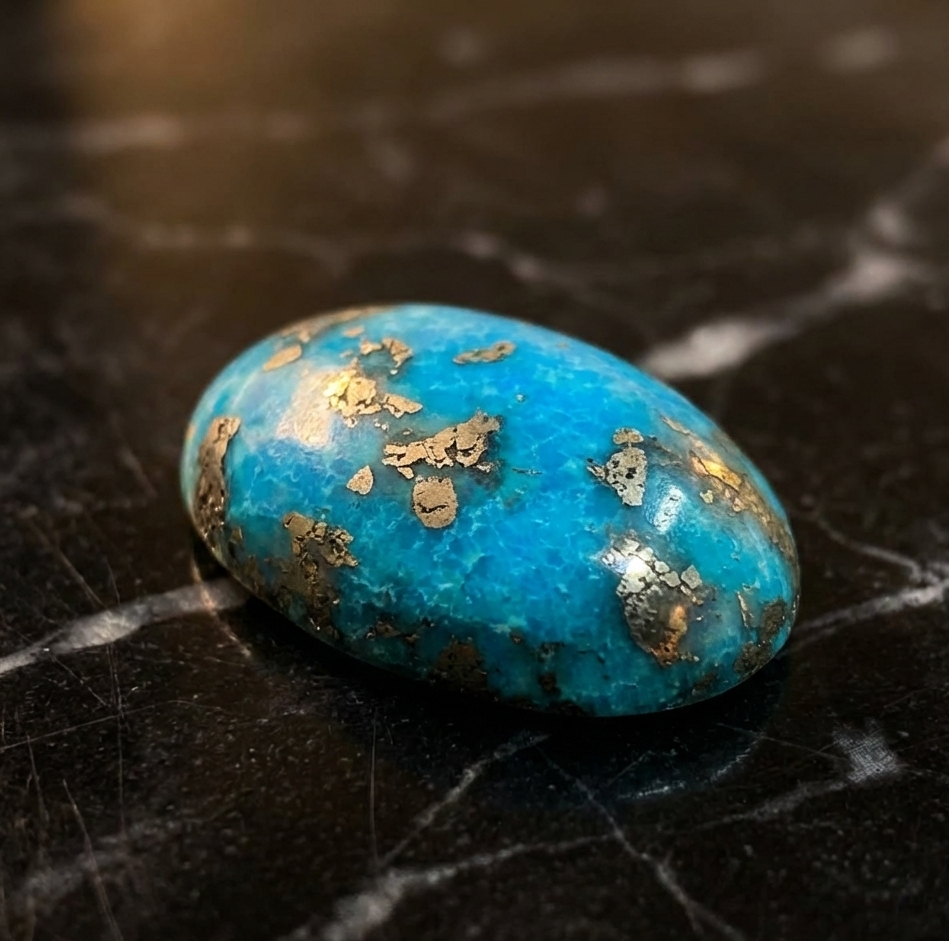
- Matrix: The dark spiderweb patterns (remnants of host rock)
- Color Range: Sky blue to greenish-blue
- Porosity: Some stones are soft, others quite hard
- Origin: Different mines produce different characteristics
At Pearl Gems Pakistan, we educate our customers about these variations. When you understand what you’re holding, the Feroza stone meaning becomes even more profound.
Global Journey, Pakistani Connection
Feroza has traveled the world, but did you know Pakistan has its own special connection?
Pakistan’s Feroza Heritage:
- Balochistan Mines: Some of the world’s finest Feroza
- Ancient Trade Routes: Through Quetta to Central Asia
- Cultural Significance: In Pashtun and Baloch jewelry traditions
- Modern Revival: Pakistani designers incorporating traditional stones
When you choose Feroza from Pearl Gems, you’re connecting with a heritage that runs through Pakistan’s mountains and history.
Chapter 2: Feroza Stone Meaning Across Cultures
Ancient Civilizations Speak
The Feroza stone meaning has evolved through millennia, but some themes remain constant:
Ancient Egypt (5,000+ years ago):
- Pharaohs’ burial masks adorned with Turquoise
- Symbol of protection in the afterlife
- Called “mefkat,” meaning “joy” and “delight”
- Cleopatra’s famous Turquoise jewelry collection
Persian Empire:
- Called “pirouzeh,” meaning “victory” — the direct root of the word “Feroza”
- Palaces and mosques decorated with Feroza tiles
- Believed to protect against unnatural death
- Warriors wore it into battle for protection
Native American Traditions:
- “Sky stone” connecting earth and heaven
- Used in rituals for rain and fertility
- Protection during travel (physical and spiritual)
Tibetan Culture:
- Temple decorations and ritual objects
- Protection against evil eye and negative energy
- Valued more than gold in ancient times
Chapter 3: Feroza Stone Benefits — Significance & Method of Wearing
At Pearl Gems Pakistan, this is one of the questions we’re asked most — is Feroza permissible, and what significance does it hold in Islam?
Traditional and cultural associations:
-
Feroza has a long-standing place in Muslim tradition, particularly in Persian, Middle Eastern, and South Asian Islamic culture, where it’s associated with protection, blessing, and clear communication. It’s one of the most commonly used stones for tasbih, and many Muslims choose it for a silver-set ring in the same tradition as Aqeeq.
For the full breakdown — whether Feroza is halal, how it should be worn, which finger tradition recommends, and who typically wears it — see our dedicated guide: Feroza Stone Benefits in Islam
- It is one of the most common stones used for tasbih (prayer beads), valued for its calming blue-green color during dhikr and prayer.
- Wearing gemstone rings — including Feroza — is a well-documented historical practice among Muslims, and many scholars consider stones like Feroza permissible ornamentation for men when set in silver rather than gold.
- Because there is genuine scholarly variation in how specific narrations about gemstones are graded, we present this as widely held cultural and traditional belief rather than a definitive religious ruling — we’d always encourage checking with a qualified scholar for guidance specific to your school of thought.
- In Pakistani and South Asian Muslim communities, Feroza is commonly gifted at weddings, births, and religious occasions as a symbol of protection and blessing.
The traditional Islamic method of wearing Feroza:
- Metal: Silver, not gold. Gold jewelry for men is prohibited in Islam, which is one reason silver-set Feroza rings have remained the standard choice for Muslim men for centuries. Women may wear Feroza set in gold or silver.
- Hand and finger: Tradition among many Muslims follows the practice associated with the Prophet’s (PBUH) own ring, worn on the right hand’s smallest finger. Some communities and schools of thought differ on the exact hand or finger, so local custom and scholarly guidance both play a role.
- Intention: Many wearers pair putting on the ring with a short dua or intention for protection and blessing, rather than treating the stone as having independent power of its own.
- As with the points above, treat this as commonly practiced tradition rather than a fixed ruling — a local scholar can confirm what applies to your specific context.
In Pakistani Culture more broadly:
- Balochistan: Traditional Feroza jewelry for brides
- Peshawar: Feroza inlaid in weapons and ornaments
- Lahore: Mughal architecture featuring Feroza tiles
- Karachi: Modern jewelry blending tradition and fashion
Looking for other stones with Islamic significance? See our guide to Aqeeq, Feroza, and Dur-e-Najaf, or browse our Tasbih collection.
Chapter 4: Feroza Healing Properties — The Body’s Blue Balm
Physical Healing Traditions
The Feroza healing properties span both ancient wisdom and modern crystal therapy. At Pearl Gems Pakistan, we present these as traditional beliefs while encouraging medical care for serious conditions.
Traditional Physical Benefits:
1. Throat and Respiratory System:
- Soothing sore throats (worn as a necklace)
- Supporting thyroid function
- Helping with breathing issues
2. Immune System Support:
- Believed to strengthen natural defenses
- Detoxifying properties
- Energy restoration during illness recovery
3. Pain Relief:
- Headache and migraine relief
- Arthritis and joint pain comfort
- General pain management
Real Experience from Pakistan: A teacher from Islamabad who bought Feroza earrings from Pearl Gems shared: “I’ve had chronic throat issues from years of teaching. Since wearing Feroza, I’ve noticed my throat feels less strained. Whether it’s the stone or my belief in it, I’m grateful.”
Modern Perspectives
Color Therapy Connection: Blue and green — the colors of Feroza — are used in modern therapy for calming anxiety, lowering blood pressure, promoting restful sleep, and reducing inflammation.
Placebo or Power? As we often discuss at Pearl Gems Pakistan: if wearing Feroza makes you more mindful of your health, encourages you to hydrate, or reminds you to rest your voice — isn’t that healing in itself?
Chapter 5: Feroza Stone Benefits — Beyond Physical Healing
Emotional and Psychological Benefits
This is where many Feroza stone benefits become life-changing:
1. Communication Enhancement:
- Speaking your truth with courage
- Improving public speaking confidence
2. Emotional Balance:
- Calming mood swings, reducing stress and anxiety
- Promoting inner peace
3. Self-Realization:
- Understanding personal patterns
- Finding life purpose clarity
Pakistani Professional’s Story: A lawyer from Lahore purchased a Feroza ring from us. She reported: “In court, I feel more articulate. I choose my words more carefully. The Feroza stone benefits for communication feel very real in my profession.”
Spiritual and Energetic Benefits
- Protection Energy: Shielding from negative influences, safe travel companion, psychic protection
- Connection Benefits: Enhancing meditation depth, strengthening intuition, balancing throat and heart chakras
- Creativity Boost: Inspiring artistic expression, overcoming creative blocks
Chapter 6: Feroza Stone Price in Pakistan — Value Guide (2026)
The Four Factors Determining Value
1. Color — the most important factor:
- Sky Blue: highest value, little to no green
- Robin’s Egg Blue: premium quality
- Greenish-Blue: more common, lower value
2. Matrix (spiderweb patterns):
- Fine, even webbing adds value (“spiderweb” Feroza)
- No matrix at all is rare and highly valued
3. Hardness and Durability:
- Hard, natural stones take polish well and last longer
- Stabilized stones are common but less valuable than natural
4. Origin and Rarity:
- Persian/Iranian: historical premium quality
- Sleeping Beauty (Arizona): consistent blue, no matrix
- Pakistani/Balochistan: unique character, growing recognition
The Pearl Gems Grading System
| Grade | Description |
|---|---|
| Grade A (Premium) | Natural, untreated, sky blue, fine or no matrix, hard, documented origin |
| Grade B (Good Quality) | May be stabilized, blue to blue-green, attractive matrix, good value |
| Grade C (Commercial) | Often treated/dyed, greenish tones, heavy matrix, affordable |
Feroza Stone Price in Pakistan — Per Carat
| Grade | Price Range (PKR/carat) |
|---|---|
| Grade A | 3,000 – 15,000+ |
| Grade B | 1,000 – 3,000 |
| Grade C | 300 – 1,000 |
Feroza Stone Price in Pakistan — Per Ratti
Most local buyers shop by ratti, not carat (1 ratti ≈ 0.91 carats). Here’s the equivalent breakdown:
| Grade | Price Range (PKR/ratti) |
|---|---|
| Grade A | 2,700 – 13,500+ |
| Grade B | 900 – 2,700 |
| Grade C | 270 – 900 |
Factors that increase value: large clean cabochons, documented origin/provenance, unique matrix patterns, rare color variations, and skilled craftsmanship in the setting. Prices fluctuate with market trends — the numbers above are a general 2026 guide, not a fixed quote; contact us directly for current pricing on a specific stone.
Chapter 7: How to Identify Authentic Feroza
Spotting Fakes and Treatments
Unfortunately, the market has many imitations. At Pearl Gems Pakistan, we teach customers to recognize authenticity:
Common Fakes:
- Howlite or Magnesite: dyed to look like Feroza
- Plastic or Resin: completely synthetic
- Reconstituted Turquoise: powdered stone mixed with resin
Identification Tips:
- Temperature Test: Real Feroza feels cool; plastic feels warm
- Magnification: Real stone shows natural imperfections
- Chemical Test: Acetone on a cotton swab — dyed stones will bleed color
- Weight: Real stone feels heavier than plastic
Treatments to Know:
- Stabilization: wax or resin to harden soft stone (common, acceptable)
- Dyeing: enhancing or changing color (reduces value)
- Reconstruction: powdered stone reformed (lowest value)
The Pearl Gems Authenticity Promise
Every Feroza at Pearl Gems Pakistan comes with a natural origin guarantee, full treatment disclosure, quality matching, and a return policy if independently verified as not as described.
Chapter 8: Wearing and Caring for Your Feroza
Traditional Wearing Methods
- Necklace/Pendant: for throat-related benefits
- Ring: traditionally on the right hand, set in silver (see Chapter 3)
- Bracelet: for overall protection and energy
- Earrings: for mental clarity and balance
Traditional Rituals:
- Cleanse in moonlight before first wear
- Set intentions while holding the stone
- Wear consistently for 40 days to establish connection
Daily Care Guide
Do: wipe with a soft, dry cloth after wearing; store separately in a soft pouch; keep away from prolonged sunlight.
Don’t: use ultrasonic cleaners; expose to perfume, lotion, or chlorine; soak in water.
Energetic Maintenance
Monthly moonlight bath, smudging, or brief morning sunlight exposure are traditional recharging methods.
Chapter 9: Feroza in Pakistani Jewelry and Fashion
Traditional Pakistani Designs
Balochi and Pashtun Styles: heavy silver settings with Feroza cabochons, forehead ornaments (jhoomar), nose rings, multi-stone necklaces.
Mughal Influence: Kundan and jadau settings, Feroza with pearls and rubies, traditional jhumkas and tikka sets.
Modern Adaptations: minimalist solitaire rings, Feroza with white gold or platinum, stackable rings and bracelets.
Styling Tips for Pakistani Wardrobe
- Shalwar Kameez: statement necklace or jhumkas
- Lehenga/Sharara: matching set for weddings
- Western Fusion: modern Feroza pieces with contemporary cuts
Chapter 10: Frequently Asked Questions
Q: Is Feroza the same as Turquoise? A: Yes. Feroza (also spelled Firoza) is simply the Persian/Urdu name for the same mineral the West calls Turquoise. There is no difference between them.
Q: What is Feroza stone called in Urdu? A: فیروزہ (Feroza/Firoza) — the same word is used across Urdu, Persian, and several South Asian languages.
Q: What is the Feroza stone price in Pakistan? A: It depends on grade, color, and origin. As a 2026 guide: Grade A runs roughly PKR 3,000–15,000+ per carat (or ~2,700–13,500+ per ratti), Grade B around PKR 1,000–3,000/carat, and Grade C around PKR 300–1,000/carat. See Chapter 6 for the full breakdown.
Q: Which finger should Feroza be worn on? A: Many Muslims follow the tradition associated with the Prophet’s (PBUH) ring, worn on the right hand’s smallest finger, set in silver. Local custom varies, so it’s worth checking with a scholar for guidance specific to your community.
Q: Is wearing Feroza permissible (halal) in Islam? A: Gemstone rings, including Feroza, have a long historical association with Muslim tradition, particularly when set in silver rather than gold (gold being prohibited for men in Islam). As with any religious question, we’d recommend confirming specifics with a qualified scholar for your context.
Q: Can men wear Feroza in Pakistan? A: Absolutely — traditional Baloch and Pashtun jewelry includes Feroza pieces for men, and modern minimalist designs are also popular.
Q: How does Pakistani Feroza compare to Persian/Iranian Feroza? A: Pakistani Feroza often has unique matrix patterns and character. Persian Feroza carries historical prestige, but Pakistani stones offer excellent quality and value.
Q: Can I wear Feroza every day? A: Yes, with proper care — just avoid heavy activity and chemical exposure (see Chapter 8).
Chapter 11: The Future of Feroza in Pakistan
Growing demand for: ethically sourced Pakistani Feroza, traditional designs with modern twists, men’s Feroza jewelry, and healing/spiritual use alongside fashion.
Sustainability considerations: supporting local Balochistan mining communities, promoting natural over heavily treated stones, and preserving traditional craftsmanship.
Investment potential: high-quality natural stones are appreciating in value, international recognition of Pakistani Feroza is growing, and limited new mine discoveries are increasing rarity over time.
To Buy Original & Authentic Feroza: Shop Turquoise/Feroza at Pearl Gems
Conclusion: Your Personal Piece of Sky
The complete Feroza stone benefits picture — its meaning, healing properties, Islamic significance and methodology, and price — comes together into one thing: a stone worth understanding before you wear it.
At Pearl Gems Pakistan, we see Feroza (Turquoise) as more than inventory. Each piece carries geological history from Pakistan’s mountains, cultural heritage from our diverse traditions, and healing potential drawn from centuries of belief across civilizations.
Discover Your Feroza at Pearl Gems Pakistan: Visit our showroom, book a virtual consultation, browse certified stones online, or request a custom design.