
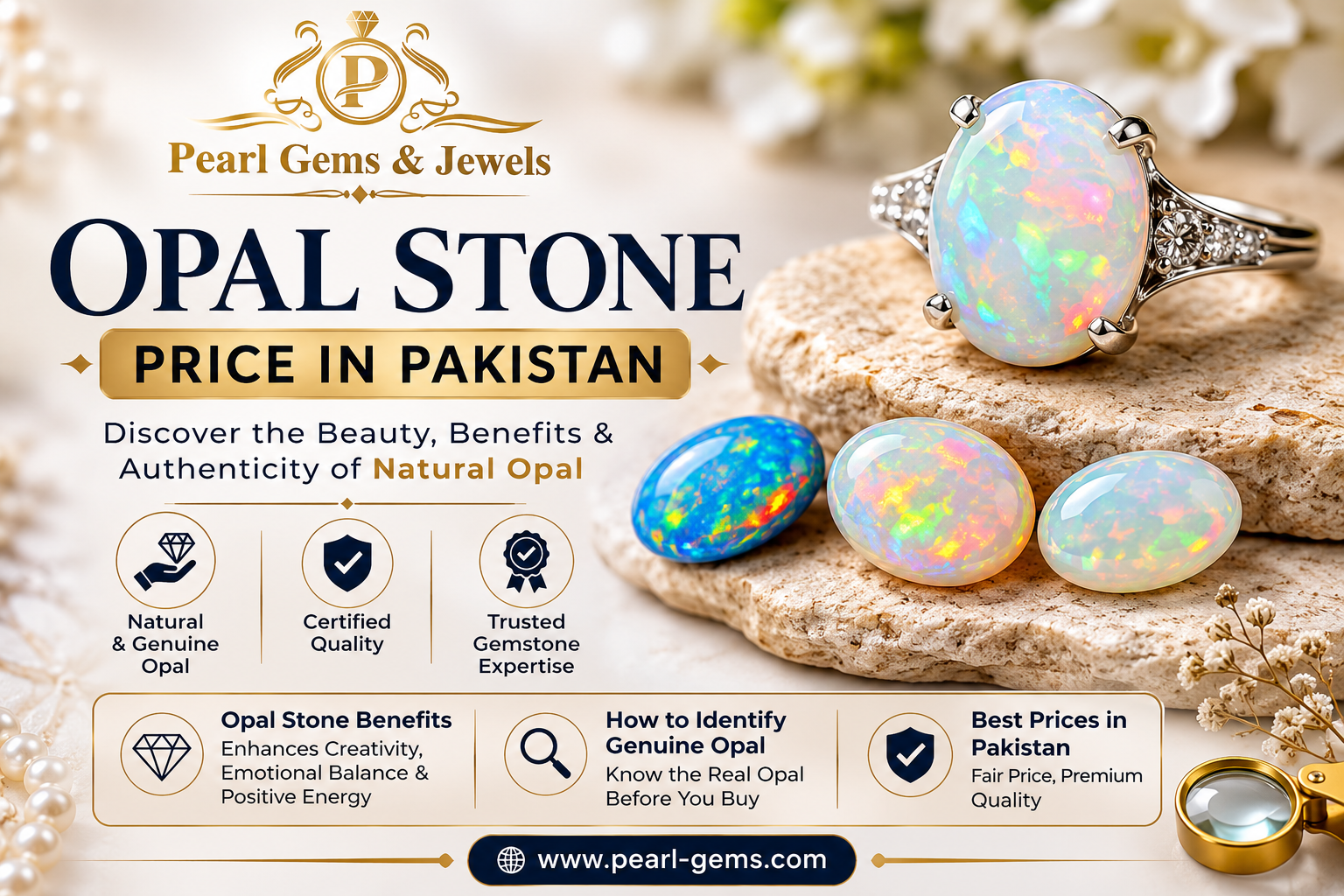
If you have been shopping around for a ring or pendant with real fire in it, you have probably landed on opal. It is the one gemstone that never looks the same twice — tilt it under the light and a whole spectrum of colour moves across the surface. Naturally, the first question most buyers ask is the opal stone price in Pakistan, and the honest answer is that it depends heavily on which type of opal you are looking at, how strong its colour play is, and where it was mined. This guide breaks down current opal rates, what actually drives the price up or down, and how to make sure the stone you buy is genuine.
What Is Opal?
Opal is not a crystal in the way sapphire or ruby is. It is a hydrated form of silica that never developed a fixed internal structure, which is why gemologists classify it as a mineraloid rather than a true mineral. That same lack of structure is what gives opal its famous “play-of-colour” — tiny silica spheres inside the stone bend light and scatter it into flashes of red, green, blue, and orange as the stone moves. No two opals produce the same pattern, so every piece is genuinely one of a kind. This uniqueness is part of why opal jewellery in Pakistan has grown so popular over the last few years, especially among buyers who want something different from the usual sapphire or ruby setting.
Types of Opal Available in Pakistan
Local jewellers and gemstone dealers typically stock a handful of opal varieties, each with its own look and price bracket.
- White or Milky Opal — Known locally as Doodhiya Opal, this is the most common type sold in Pakistan. It has a pale, milky base with soft flashes of colour and is the most budget-friendly entry point into opal.
- Black Opal — The rarest and most prized type. Its dark body tone makes the colour flashes appear far more vivid and saturated, which is why it commands the highest prices.
- Blue or Water Opal — A translucent, gentle blue stone, usually sourced from Ethiopia, with little to no fire. It is a favourite for buyers who want the opal look without paying for strong colour play.
- Fire Opal — Recognisable by its warm orange-to-red base tone. Genuine fire opal with a bright, transparent body is one of the more expensive varieties per carat.
- Boulder and Crystal Opal — Boulder opal forms attached to its host rock, while crystal opal is more transparent with a strong, visible play of colour. Both are less common in the local market and priced accordingly.
Most of what circulates in Pakistan’s gemstone bazaars is Ethiopian opal, prized for its clarity and affordability, alongside a smaller supply of Australian opal, which tends to carry the strongest and most valuable colour patterns.
Opal Stone Price in Pakistan (Current Rates)
Because every opal is unique, pricing is judged stone by stone rather than off a fixed rate card — but buyers still want a realistic starting point. Based on current market activity and our own inventory, here is what you can expect per carat:
| Opal Type | Typical Price Range (PKR per carat) |
|---|---|
| White / Milky Opal (Doodhiya Opal) | ₨1,200 – 3,500 |
| Black Opal | ₨1,200 – 4,000+ (strong-flash pieces cost significantly more) |
| Blue / Water Opal (Ethiopian) | ₨800 – 2,000 |
| Fire Opal (orange-red) | ₨3,000 – 10,000+ |
| Boulder / Crystal Opal | ₨2,000 – 8,000 |
At Pearl Gems Pakistan, our current starting rate for both natural Black Opal and White Opal is ₨1,200 per carat, with pricing rising from there based on the strength and spread of colour flash in the individual stone. A plain, low-fire opal will sit near the lower end of the range, while a stone with bold, broad colour bars — particularly in black or fire opal — can move well beyond it. Rates also shift with silver and international gemstone market movements, so it is always worth confirming the current rate for the exact carat weight and grade you have in mind.
What Affects Opal Price in Pakistan
A handful of factors decide where any individual opal lands on the price scale.
Play of colour. This is the single biggest driver of value. A stone that flashes multiple bright colours across a wide area is worth far more than one with a single faint colour in a small patch.
Body tone. Darker base tones (as seen in black opal) make colours appear more intense and saturated, which is why black opal consistently sells for more than white opal of similar size and pattern.
Origin. Australian opal is generally considered the benchmark for quality and tends to command higher prices, while Ethiopian opal — the more common source for Pakistani buyers — offers excellent clarity and colour at a more accessible price point.
Carat weight and cut. As with most gemstones, larger stones are rarer and priced higher per carat, not just in total. A well-proportioned cabochon cut that shows off the colour play evenly also adds value.
Treatment and construction. A solid, natural opal is worth more than a doublet or triplet (thin layers of opal bonded to a backing material), which are common in the market and priced lower because they use less natural opal.
If you are comparing prices across different gemstones, our complete guide to gemstone pricing in Pakistan covers the broader factors — origin, treatment, and clarity — that apply across nearly every coloured stone we sell.
Loose Opal vs. Set Jewellery: What Changes the Price
Most price lists, including the table above, quote loose (unset) opal by the carat. Once you move to a finished ring, pendant, or pair of earrings, the total cost shifts based on a few extra factors worth budgeting for.
Metal choice. Silver is by far the most common and affordable setting for opal in Pakistan, keeping the overall piece budget-friendly. Gold settings add a noticeable premium on top of the stone’s own price.
Setting style. A simple bezel setting, which wraps a protective rim of metal around the stone’s edge, tends to cost less than an open-claw setting and offers better day-to-day protection for a soft stone like opal.
Custom work. If you already own an opal and want it reset into a new design, expect an additional labour charge on top of the stone’s value — this varies by jeweller and design complexity rather than following a fixed rate.
As a rule of thumb, budget the carat price of the stone itself first, then add roughly 15–30% for a straightforward silver setting, more for gold or an elaborate custom design.
How to Identify Genuine Opal
Because opal is soft and relatively easy to imitate, it is worth knowing what to look for before you buy.
- Check the colour movement. Genuine opal shows colour that shifts and changes as you tilt the stone under light. Glass or plastic imitations tend to look static or have colour painted in flat, uniform patches.
- Ask about doublets and triplets. These are real opal, just thinly sliced and bonded to a dark backing (doublet) or topped with a protective clear layer as well (triplet). They are legitimate products but should be priced and sold as such, not passed off as solid opal.
- Feel for a slightly soft surface. Opal sits at 5 to 6.5 on the Mohs hardness scale, noticeably softer than sapphire or quartz-based stones, so it can show fine wear over time if handled roughly.
- Request a lab certificate. This is the only reliable way to confirm you are buying a natural, untreated stone rather than a doublet, triplet, or synthetic (Gilson) opal. Any seller working in good faith should be able to provide one on request.
Opal Stone Benefits, Meaning & Zodiac Significance
Opal is the recognised birthstone for October and is traditionally associated with the zodiac signs Libra and Scorpio, and by extension is often recommended for people born under these signs seeking added confidence and emotional balance. In Pakistani astrological practice, Doodhiya Opal is generally described as a stone of joy and affection, commonly suggested for individuals born under Scorpio and Sagittarius.
Beyond astrology, opal is widely worn simply for its striking, one-of-a-kind beauty — no two stones ever look alike, which makes it a personal and distinctive choice for rings, pendants, and earrings. Many buyers also value it as a centrepiece stone precisely because its colour play makes it stand out from more common clear or single-toned gems. If you are drawn to gemstones with this kind of shifting colour effect, Labradorite is another stone in our collection worth a look — it produces a similar flash, known as labradorescence, in blues and greens.
How to Wear and Care for Your Opal
Because opal is softer than many other gemstones, it needs a bit more care than something like sapphire or amethyst.
- Avoid wearing opal jewellery during heavy manual work, gym sessions, or housework where it could be knocked or scratched.
- Keep it away from direct heat and sudden temperature changes, which can cause fine internal cracks (known as “crazing”) over time.
- Clean it gently with a soft, damp cloth rather than ultrasonic cleaners or harsh chemicals.
- Store it separately from harder gemstones so it does not get scratched in your jewellery box.
- Pendants and earrings tend to suit opal better than everyday rings, simply because they see less friction and impact.
Setting opal in silver, which is a common local preference, also gives the stone a cooler, more contemporary look that pairs well with its pale or dark body tones.
Why Buy Opal from Pearl Gems Pakistan
We source our opal — including our Black, White, Blue Water, and Honey Ethiopian varieties — with a focus on natural, untreated stones and straightforward pricing. Every piece in our collection is listed with its actual carat weight and price, so you know exactly what you are paying for before you buy, and we are happy to talk you through the play of colour, origin, and grade of any specific stone over WhatsApp before you commit. Delivery is available across Pakistan, from Lahore and Karachi to Islamabad and beyond.
Frequently Asked Questions
What is the price of opal per carat in Pakistan? Prices generally start around ₨1,200 per carat for standard White or Black Opal and can rise well beyond ₨10,000 per carat for fire opal or black opal with strong, broad colour play. The exact rate depends on body tone, origin, and pattern strength.
Is black opal more expensive than white opal? Yes, in most cases. Black opal’s dark base tone makes its colour flashes appear brighter and more saturated, which is why it typically commands a higher price than white opal of similar size and quality.
How can I tell if my opal is real? Look for colour that shifts as the stone moves rather than staying static, and ask for a lab certificate. Genuine opal also has a slightly softer surface than most other gemstones, unlike glass or plastic imitations.
Which zodiac sign should wear opal? Opal is traditionally linked to Libra and Scorpio as the October birthstone, and in local astrological practice it is commonly recommended for Scorpio and Sagittarius as well.
What is the difference between a doublet, a triplet, and solid opal? Solid opal is one continuous piece of natural stone. A doublet is a thin slice of opal bonded to a dark backing, while a triplet adds a clear protective cap on top of that. All three are genuine opal, but solid stones carry the highest value since they use more natural material.
Is Ethiopian opal or Australian opal better? Neither is strictly “better” — they simply differ. Ethiopian opal is generally more affordable and widely available in Pakistan with strong clarity, while Australian opal is prized for its colour intensity and pattern, which usually places it at a higher price point.
Can opal be worn every day? It can, but because it is softer than most gemstones, opal suits pendants and earrings better than rings worn during physical activity. If you do wear it daily as a ring, handle it with a bit more care than you would a harder stone.