
Nature’s Art in Crystal Form
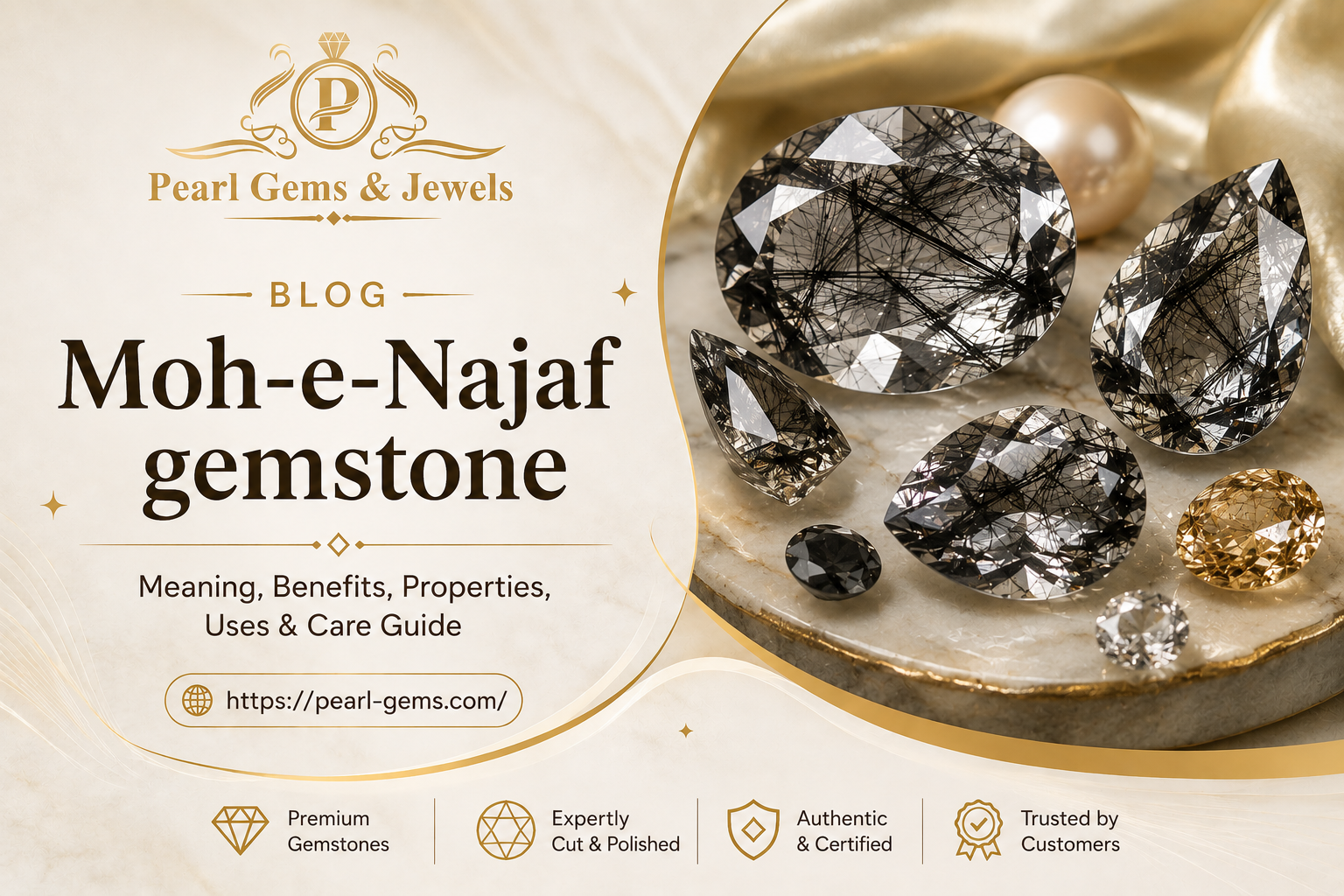
Imagine holding a piece of crystallized sunlight — where golden needles dance inside transparent stone like frozen fireworks. This is the extraordinary beauty of the moh-e-najaf gemstone, one of the most spiritually significant and visually stunning stones in Pakistan’s rich gemstone heritage.
Known in the Western world as the rutile quartz gemstone and poetically called Venus Hair Stone, Moh-e-Najaf has been treasured across the Muslim world for centuries. This remarkable crystal combines the clarity of quartz with the striking visual drama of needle-like rutile inclusions — and no two pieces are ever alike.
At Pearl Gems Pakistan, we have witnessed growing fascination with this unique stone. From collectors in Karachi marveling at its internal landscapes, to spiritual seekers in Lahore drawn to its powerful energy, the moh-e-najaf gemstone holds a place in Pakistani culture that no other gem quite matches. Its name connects wearers to the holy city of Najaf in Iraq, while its scientific marvel appeals equally to modern sensibilities.
This comprehensive guide covers everything you need to know about the moh-e-najaf gemstone — its physical properties, spiritual significance, value factors, Pakistani origins, and how to buy with complete confidence. Whether you are a collector, jewelry enthusiast, or spiritual seeker, this knowledge will deepen your appreciation and help you make informed choices.
Chapter 1: What Is the Moh-e-Najaf Gemstone?
The Science Behind the Beauty
The moh-e-najaf gemstone — known scientifically as rutile quartz — is a variety of quartz containing needle-like inclusions of the mineral rutile (titanium dioxide, TiO₂) embedded within its crystal structure. According to gemological reference standards, these inclusions can be golden, reddish, silvery, or rarely greenish, creating stunning visual effects that make every single piece completely unique.
The formation process is one of nature’s most fascinating geological events. Rutile needles grow first inside an empty cavity deep underground. Later, silica-rich fluids slowly fill the same space, hardening into quartz and permanently preserving the delicate needle-like structures. This geological miracle takes millions of years — resulting in the breathtaking specimens we treasure today.
The Meaning Behind the Name “Moh-e-Najaf”
In Pakistan and across the Muslim world, this gemstone is known as Moh-e-Najaf (موہ نجف). The name carries layered cultural and spiritual significance:
- “Moh” means hair — referring directly to the hair-like rutile inclusions
- “Najaf” connects the stone to the holy city of Najaf in Iraq
Technically, genuine Moh-e-Najaf refers specifically to rutile quartz found in the Wadi-us-Salaam cemetery area of Najaf, Iraq. However, the name is now widely used throughout Pakistan for all rutile quartz regardless of origin. At Pearl Gems Pakistan, we maintain full transparency about the source of every stone we sell — helping every customer understand this important distinction.
Why Is It Also Called “Venus Hair Stone”?
The romantic Western name Venus Hair Stone comes from ancient Greek mythology. According to legend, the goddess Venus (Aphrodite) was bathing in a crystal-clear pool when she lost a lock of her golden hair. The hair sank and transformed into stone — creating the beautiful golden needles visible within the quartz. Another version tells of Venus getting her hair caught on underwater rocks, with mermaids fighting over the golden strands until the goddess turned them to stone in anger.
These myths speak to something real: the moh-e-najaf gemstone genuinely looks like hair frozen in glass. The visual illusion is so striking that people across cultures and centuries have been moved to create stories around it.
Understanding Moh-e-Najaf
In Pakistan and across the Muslim world, the rutile quartz gemstone is commonly known as Moh-e-Najaf (موہ نجف). This name carries deep cultural and spiritual significance. “Moh” means hair — referring to the hair-like inclusions — while “Najaf” connects the stone to the holy city of Najaf in Iraq.
It is important to understand that genuine Moh-e-Najaf technically refers to rutile quartz found specifically in the Wadi-us-Salaam cemetery area of Najaf, Iraq. However, the name is now broadly used throughout Pakistan for all rutile quartz, regardless of origin. At Pearl Gems Pakistan, we maintain full transparency about the source of every stone we sell, helping customers understand this distinction clearly.
Is Moh-e-Najaf the Same as Dur-e-Najaf?
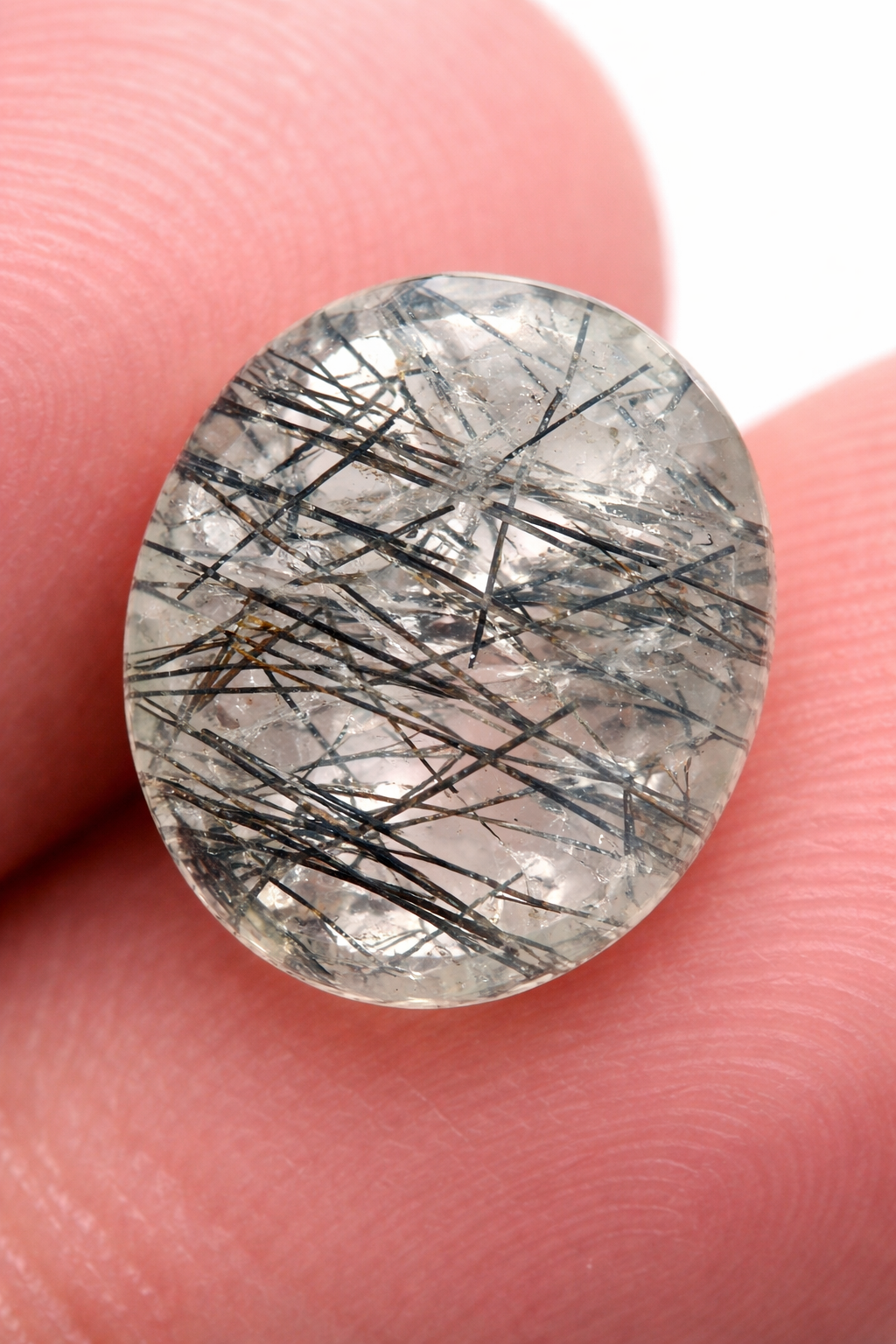
This is one of the most common points of confusion in the Pakistani gemstone market. The moh-e-najaf gemstone contains clearly visible needle-like rutile inclusions inside the quartz. Dur-e-Najaf, on the other hand, is typically a clear, glassy quartz without inclusions — also sourced from Najaf, but a completely different stone in appearance and properties. At Pearl Gems Pakistan, we educate every customer about these differences to ensure they purchase exactly what they are looking for.
Chapter 2: Physical Properties of Moh-e-Najaf Gemstone
Chemical Composition
The moh-e-najaf gemstone (rutile quartz) is formed from two distinct minerals:
- Host Crystal: Quartz (Silicon Dioxide — SiO₂)
- Inclusions: Rutile (Titanium Dioxide — TiO₂)
Hardness and Durability
| Property | Value |
|---|---|
| Mohs Hardness (Quartz Host) | 7 |
| Rutile Hardness | ~6 to 6.5 |
| Overall Durability | Good — suitable for jewelry with proper care |
(Hardness values per standard mineralogical reference: quartz Mohs 7, rutile Mohs 6–6.5)
The hardness difference between quartz and rutile creates interesting challenges for gem cutters. Because rutile is slightly softer than the quartz host, achieving a perfectly smooth polished surface without pits requires skill and experience. At Pearl Gems Pakistan, we work exclusively with craftsmen who understand these nuances.
Optical Properties
| Property | Value | Source |
|---|---|---|
| Refractive Index | 1.544 to 1.553 | Standard gemological reference |
| Specific Gravity | 2.65 (quartz host) | Standard gemological reference |
| Lustre | Vitreous (glassy) | |
| Transparency | Transparent to translucent | |
| Crystal System | Trigonal |
Color Variations
The color of the rutile inclusions defines each moh-e-najaf gemstone’s character:
- Golden Rutile — Most common and sought-after; associated with solar energy and prosperity
- Red Rutile — Iron-rich inclusions; linked to vitality and passion
- Silver Rutile — Elegant, moon-like appearance; connected to intuition
- Black Rutile — Powerful grounding and protective energy
- Copper Rutile — Warm tones associated with creativity and wealth attraction
- Smoky Rutile — Combination of smoky quartz with rutile; excellent for transformation
Chapter 3: Pakistani Moh-e-Najaf Gemstone — World-Class Quality
Pakistan’s Exceptional Deposits
Pakistan is blessed with some of the finest moh-e-najaf (rutile quartz) gemstone deposits in the world. The quality of Pakistani material rivals — and in many cases surpasses — specimens from any other country. At Pearl Gems Pakistan, we are proud to showcase locally sourced stones:
Zagi Mountain, Khyber Pakhtunkhwa Produces superb rutile quartz crystals with perfectly terminated, flawless, glassy faces and pristine clarity. Golden rutile needles are sharply defined and beautifully distributed — creating dramatic internal landscapes that collectors across the world actively seek.
Shigar Valley, Gilgit-Baltistan Known for stunning sagenitic quartz with intricate lattice patterns of golden-red rutile needles arranged in precise geometric networks. These specimens display remarkable transparency and a three-dimensional depth that photographs cannot fully capture — they must be seen in person.
Global Sources of Rutile Quartz Gemstone
The moh-e-najaf gemstone is found across multiple continents, each source with its own character:
| Origin | Notable Characteristic |
|---|---|
| Iraq (Najaf) | Sacred source; carries cultural and spiritual premium |
| Brazil | Historical prestige; often features rare star-shaped patterns |
| Madagascar | Red, golden, or silver inclusions |
| India | Earthy copper and red hues |
| Sri Lanka | High clarity with delicate rutile needles |
| United States | Varied formations |
| Australia / Kazakhstan / Russia | Collector-grade material |
While global sources each have their merits, Pakistani moh-e-najaf gemstone specimens are increasingly recognized internationally as among the world’s finest — for both specimen collecting and fine jewelry.
Chapter 4: Value Factors — What Determines Moh-e-Najaf Gemstone Price?
Understanding what drives value will help you shop with confidence — whether you are buying your first moh-e-najaf gemstone or adding a collector specimen to an established collection.
1. Clarity of the Host Quartz
The quartz host should be as transparent as possible. High clarity allows the rutile inclusions to be visible in extraordinary detail, appearing to float within glass. Cloudy or heavily included quartz significantly reduces both visual appeal and market value.
2. Quality of Rutile Inclusions
Four sub-factors determine inclusion quality:
- Distribution — Evenly spread needles throughout the stone are most desirable
- Density — Enough needles to create strong visual interest without overcrowding
- Color — Golden needles are most prized, followed by red, then silver
- Sharpness — Crisp, well-defined needles versus fuzzy or partially dissolved inclusions
3. Unique Pattern Formations
Certain rare patterns command significant premiums:
Sagenitic Patterns: Geometric, lattice-like networks of rutile needles creating mesmerizing three-dimensional depth. Pakistani specimens from Shigar Valley frequently exhibit this formation and are highly valued by international collectors.
Star Patterns: Rare formations where needles radiate outward in star-like arrangements. Among the most scarce moh-e-najaf gemstone formations — and among the most valuable.
4. Size and Cut Quality
Larger, expertly-cut specimens command higher prices. Pakistani rutile quartz specimens in the 500-gram range have been listed by specialist mineral dealers at approximately $3,400, while quality sagenitic pieces in the 120-gram range are priced around $1,600 — showing clearly how size and pattern formation work together to set value.
5. Origin Premium
Iraqi Moh-e-Najaf from Najaf carries a significant cultural and spiritual premium for Pakistani buyers. Brazilian rutile quartz carries historical collector prestige internationally. Pakistani material increasingly commands its own premium based on specimen quality alone.
Moh-e-Najaf Gemstone Price in Pakistan (Updated May 2026)
At Pearl Gems Pakistan, we offer stones at every price point:
| Quality Level | Price Range (PKR) | Characteristics |
|---|---|---|
| Commercial Grade | 500 – 2,000 per piece | Smaller stones, minor clarity issues |
| Good Quality | 2,000 – 10,000 per carat | Clear quartz, good needle distribution |
| Premium Quality | 10,000 – 50,000+ per carat | Exceptional clarity, unique patterns, larger size |
| Collector Specimens | 50,000 – 500,000+ | Museum-quality, sagenitic patterns, rare formations |
Ready to find your stone?Browse our Moh-e-Najaf collection or contact our team for a free consultation — we help every buyer find the right stone for their budget and purpose. For a carat-by-carat price breakdown specific to loose stones and rings sold in Pakistan, see our Moh-e-Najaf Stone Price in Pakistan guide.
Chapter 5: Spiritual and Healing Properties of Moh-e-Najaf Gemstone
Significance in Islamic Tradition
In Islamic tradition, the moh-e-najaf gemstone carries a level of spiritual significance that sets it apart from virtually every other stone worn in Pakistan. Key traditional beliefs include:
- Believed to bring happiness and deep contentment to the wearer
- Said to benefit eye health and reduce related ailments
- Associated with increased joy, inner peace, and self-knowledge
- Believed to balance all seven color rays in the physical and subtle bodies
Imam Jaffar-e-Sadiq and Imam Hassan al-Askari (AS) are reported in classical Islamic gem literature (referenced in Bihar al-Anwar, the encyclopedic hadith collection by Allama Majlisi) to have recommended wearing the moh-e-najaf gemstone for its spiritual reward (sawab). According to this tradition, at every glance toward the stone, Allah grants the wearer reward equivalent to Ziyarat, Hajj, and Umrah — making it among the most spiritually significant gemstones a Muslim can wear.
Metaphysical Benefits of Rutile Quartz Gemstone
Beyond Islamic tradition, the rutile quartz gemstone is widely recognized in crystal healing traditions for its powerful properties:
Spiritual Growth Believed to infuse the spirit with vibrations of light and joy. Encourages stepping into one’s spiritual greatness, enhances psychic and intuitive gifts, and strengthens connection to higher guidance. Many wearers report a sustained sense of divine protection.
Emotional Healing Carries hopeful, uplifting energy said to bring peace to hearts and minds. Associated with new beginnings — helping wearers establish positive habits, stabilize romantic relationships, and move through life with greater emotional resilience. Crystal traditions consider it a natural anti-depressant stone.
Mental Clarity Traditionally associated with sharpened memory and enhanced focus — making it popular among students and professionals in Pakistan’s major cities. Said to reduce procrastination, encourage ambition, and support clear, purposeful decision-making.
Color-Specific Spiritual Properties
Golden Moh-e-Najaf Gemstone Empowers prosperity, happiness, and personal growth. Connected to solar energy and the solar plexus chakra. Believed to enhance clarity of thought and dispel negative energy from one’s surroundings.
Red Rutile Quartz Gemstone Associated with strength, vitality, and passion. Said to invigorate the root chakra, promoting feelings of safety, balance, and courage in daily life.
Silver Rutile Quartz Gemstone Related to intuition, clarity, and spiritual purification. Traditionally used to achieve a calm, disturbance-free mental state and a deeper sense of closeness to the Divine.
Black Rutile Quartz Gemstone Considered one of the most powerful grounding and protective stones available. Acts as a shield against negative energies. Believed to reduce fear and build inner strength for daily challenges.
Chapter 6: How to Wear and Use Moh-e-Najaf Gemstone
Jewelry Options
At Pearl Gems Pakistan, we offer the moh-e-najaf gemstone in a variety of jewelry formats:
- Rings — Most popular choice in Pakistan; gold settings complement golden rutile beautifully
- Pendants — Keeps the stone near the heart and throat chakras; excellent for daily spiritual connection
- Bracelets — Continuous skin contact throughout the day; beaded styles allow multiple stones together
- Earrings — Positions the stone’s energy near the head for enhanced mental clarity
Metal Pairing Guidelines
| Inclusion Color | Recommended Metal |
|---|---|
| Golden rutile | Yellow gold |
| Silver / gray rutile | Silver or white gold |
| Black / green inclusions | Silver or white gold |
| Copper rutile | Rose gold or yellow gold |
Meditation with Moh-e-Najaf Gemstone
Preparation: Cleanse your stone before first use. Find a quiet space. Hold the stone in your receiving (non-dominant) hand.
Process: Focus on golden light flowing outward from the stone. Visualize the rutile needles as pathways of light moving through your body. Set your intention clearly. Maintain this state for 15 to 30 minutes.
Specific Intentions:
- For clarity → Hold to the third eye (forehead center)
- For healing → Place gently on the affected area
- For manifestation → Hold while visualizing your desired outcome with full detail
Home and Office Placement
- Work desk — Enhances focus, creative thinking, and productivity
- Meditation space — Amplifies spiritual practice and intention-setting
- Bedroom — Promotes peaceful sleep and vivid dream recall
- Home entrance — Traditionally placed to protect against negative energies
Chapter 7: How to Identify Authentic Moh-e-Najaf Gemstone
What Genuine Stones Look Like
Knowing how to identify a real moh-e-najaf gemstone protects you from overpaying or being misled. At Pearl Gems Pakistan, we teach every customer the key visual signs:
Genuine moh-e-najaf gemstone features:
- Natural-looking needle inclusions — never perfectly uniform
- Needles appear to float at different depths within the quartz
- A clear three-dimensional effect when the stone is slowly rotated
- Natural variations in inclusion density across different areas of the stone
A Real Example from Our Experience
Over the years, we have examined hundreds of stones submitted by customers who suspected they had purchased fakes. One of the most common counterfeits we encounter is glass with metallic paint flakes suspended inside — sold as moh-e-najaf at markets in Karachi and Lahore. The difference becomes immediately obvious under a loupe: the paint flakes sit at a single depth with no variation, and rotating the stone shows no parallax movement between the “inclusions” and the surface. In genuine rutile quartz, the needles shift position relative to each other as you rotate the stone — a simple, reliable test any buyer can perform before purchasing.
We have also seen clear acrylic rods with tinsel embedded inside, sold as “premium Iraqi Moh-e-Najaf” at prices well above market rate. If the inclusions look too perfect — too evenly spaced, too identical in length — treat that as a warning sign.
Common Fakes to Avoid
Glass Imitations Inclusions are painted on the surface or suspended uniformly without depth. The clear giveaway is the complete absence of three-dimensional variation and organic irregularity.
Synthetic Rutile Synthetic rutile has been produced since 1948 for industrial use. However, a natural moh-e-najaf gemstone has organic complexity — depth, irregularity, and character — that synthetic material cannot convincingly replicate.
Misidentified Stones Other included quartz varieties are sometimes sold as moh-e-najaf or rutile quartz. Knowing that genuine rutile inclusions are sharply needle-like, metallic in appearance, and genuinely three-dimensional helps you identify authentic material.
The Pearl Gems Authenticity Promise
Every moh-e-najaf gemstone from our collection includes:
- Natural origin guarantee
- High-clarity photography clearly showing inclusions
- Full origin information when available
- Return policy for complete peace of mind
Chapter 8: Caring for Your Moh-e-Najaf Gemstone
Daily Physical Care
Cleaning:
- Rinse gently under lukewarm running water
- Wipe clean with a soft, lint-free cloth
- Use mild soap only when necessary
What to Avoid:
- Ultrasonic cleaners — vibrations can damage delicate rutile inclusions
- Harsh chemical cleaners or bleach
- Sudden extreme temperature changes
- Prolonged direct sunlight — can gradually fade some color variations
Storage
- Store separately from harder gemstones that could scratch the quartz surface
- Use a soft pouch or cloth-lined compartment
- Avoid contact with metals or other stones during storage
Energetic Cleansing (Traditional Methods)
- Overnight exposure to moonlight
- Brief morning sunlight (exercise caution with color-sensitive stones)
- Smudging with incense smoke — frankincense is traditional
- Burying in clean earth for 24 hours
Chapter 9: Moh-e-Najaf Gemstone in Pakistani Culture
Growing Popularity Across Pakistan
At Pearl Gems Pakistan, we observe accelerating demand for the moh-e-najaf gemstone from every region of Pakistan:
- Karachi — Collectors seeking rare specimens and statement jewelry
- Lahore — Spiritual seekers drawn to Islamic tradition and healing properties
- Islamabad — Professionals who value the mental clarity and focus benefits
- Multan — Traditional families seeking Moh-e-Najaf specifically for spiritual blessings (barakah)
What Our Customers Say
“I purchased a golden moh-e-najaf ring from Pearl Gems for my mother. The clarity of the stone was unlike anything I had seen in local markets — you could see every needle floating inside. She has worn it daily for six months and it still looks perfect.” — A. Malik, Lahore
“I was skeptical about buying gemstones online, but Pearl Gems sent detailed photographs of the actual stone before shipping. The inclusion pattern was exactly as shown. Very honest dealing.” — M. Farooqi, Karachi
Cultural and Spiritual Significance
The moh-e-najaf gemstone occupies a unique position in Pakistani culture. Its name directly connects Pakistani Muslims to the holy city of Najaf, creating a spiritual resonance that extends far beyond the stone’s physical beauty. Many customers choose it not for aesthetics alone, but for the blessings associated with its sacred namesake. This dual identity — as both a scientifically fascinating rutile quartz gemstone and a spiritually meaningful Islamic stone — gives Moh-e-Najaf a cultural depth that is genuinely unique.
Modern Trends
Younger Pakistanis are rediscovering the moh-e-najaf gemstone through several converging forces:
- Social media exposure to crystal healing and wellness culture
- Growing interest in unique, non-traditional engagement and statement stones
- Appreciation for wearable natural art that no factory can reproduce
- A desire to reconnect with heritage through traditional names and practices
Chapter 10: Frequently Asked Questions
Q: What is moh-e-najaf gemstone?
Moh-e-Najaf is the Pakistani and Islamic name for the rutile quartz gemstone — a variety of clear quartz containing needle-like inclusions of the mineral rutile (titanium dioxide). The name refers to hair-like inclusions connected to the holy city of Najaf, Iraq. It is also called Venus Hair Stone in Western gemology.
Q: Is moh-e-najaf gemstone the same as rutile quartz?
Yes. Moh-e-Najaf is the cultural and spiritual name used in Pakistan, while rutile quartz gemstone is the scientific and international name. They refer to the same stone. Technically, genuine Moh-e-Najaf comes from Najaf, Iraq, but the name is broadly used in Pakistan for all rutile quartz.
Q: Can Muslims wear moh-e-najaf gemstone?
Yes. Many Muslims wear the moh-e-najaf gemstone for its beauty and traditional spiritual blessings. Islamic tradition does not prohibit wearing natural gemstones, and its connection to Najaf adds meaningful spiritual significance for many wearers across Pakistan.
Q: Which finger should I wear moh-e-najaf on?
There is no fixed rule in Islamic tradition. You may wear it on any finger according to personal preference and comfort.
Q: What is the best day to start wearing moh-e-najaf gemstone?
Traditional practice does not specify a particular day. You may begin wearing it whenever you personally feel ready.
Q: How can I tell if my moh-e-najaf gemstone is real?
Look for natural needle-like inclusions with genuine three-dimensional depth when you rotate the stone slowly. Authentic stones have organic variation — no two are identical. A simple test: genuine rutile needles shift position relative to each other as you rotate the stone. Always purchase from reputable dealers like Pearl Gems Pakistan who back authenticity with a written guarantee.
Q: What is the moh-e-najaf gemstone price in Pakistan?
Prices range widely by quality — from PKR 500 for commercial-grade pieces to PKR 500,000+ for rare collector specimens with exceptional sagenitic patterns. Good-quality stones suitable for jewelry typically range from PKR 2,000 to PKR 10,000 per carat. Prices updated May 2026.
Q: Can I wear moh-e-najaf every day?
Yes, with appropriate care. The rutile quartz gemstone has a Mohs hardness of 7, making it suitable for regular wear. Avoid wearing it during heavy physical work or activities that risk a hard impact.
Q: Is moh-e-najaf the same as dur-e-najaf?
No. Moh-e-Najaf contains clearly visible needle-like rutile inclusions. Dur-e-Najaf is typically a clear quartz without inclusions. They are distinct stones from the same region with different appearances, properties, and uses.
Chapter 11: Buying Guide — What to Look For
For Jewelry
- Prioritize good clarity in the quartz host stone
- Confirm the rutile inclusions are attractively and evenly distributed
- Choose a size appropriate for the intended ring, pendant, or setting
- Select an inclusion color that aligns with your personal style and metal preference
For Collecting
- Seek distinctive formations — sagenitic lattice patterns and star patterns command the highest values
- Look for larger specimens with exceptional, cloud-free clarity
- Documented Pakistani origin increasingly adds collectible value internationally
- Consider how the stone sits and how light moves through it for display purposes
For Spiritual Use
- Trust your own intuitive response when handling the stone
- Cleanse thoroughly before first use
- Set clear intentions from the beginning
- Choose inclusion color based on your specific desired benefit
Questions to Ask Before Buying
- Is this a natural moh-e-najaf / rutile quartz gemstone?
- What is the geographic origin of this stone?
- Has this stone been treated or enhanced in any way?
- May I view it under different lighting conditions?
- What is your return or exchange policy?
Chapter 12: Why Choose Pearl Gems Pakistan
Our Commitment to Quality
At Pearl Gems Pakistan, our reputation is built on five principles we do not compromise on:
Authenticity Guaranteed Every moh-e-najaf gemstone in our collection is carefully examined and verified. We do not sell synthetic, treated, or misrepresented material.
Ethical Sourcing We work with suppliers who respect local mining communities and environmental responsibility. Every stone has a traceable, ethical chain of custody.
Customer Education We believe informed customers make better decisions. Our team answers every question honestly — without pressure to buy.
Competitive Pricing Direct sourcing relationships and fair margins mean genuine value for every rupee spent.
Nationwide Service From Karachi to Peshawar, Lahore to Quetta — we serve customers across Pakistan with reliable, trackable delivery.
Our Moh-e-Najaf Collection
- Loose Stones — Various sizes, inclusion colors, and quality grades
- Finished Jewelry — Rings, pendants, bracelets, and earrings
- Specimen Pieces — For serious collectors
- Custom Orders — Bring your own design concept
Conclusion: The Timeless Beauty of Moh-e-Najaf Gemstone
The moh-e-najaf gemstone is one of nature’s most extraordinary creations — a stone that bridges science, spirituality, culture, and art in a single transparent crystal. Each piece represents millions of years of geological processes, producing an internal landscape that no human hand could design or replicate.
Whether you seek it as a rutile quartz gemstone for its collector value, as Venus Hair Stone for its legendary beauty, or as the spiritually revered Moh-e-Najaf for its Islamic significance — this stone offers something genuinely rare: beauty that captures light and imagination, properties that support wellbeing, and a connection to traditions spanning cultures and millennia.
At Pearl Gems Pakistan, we are honored to share these treasures with customers across Pakistan. Every moh-e-najaf gemstone we sell carries not just its remarkable physical properties, but the wonder of nature’s artistry and the trust of everyone who chooses us.
Your journey with the moh-e-najaf gemstone begins here — with knowledge, authenticity, and beauty that lasts forever.
Explore Our Collections at Pearl Gems Pakistan:
- Moh-e-Najaf Special Collection
- Golden Rutile Quartz Gemstone
- Rutile Quartz Jewelry
- Collector Specimens
Visit us:
- Showroom: Experience moh-e-najaf gemstone beauty in person
- Online Store: Browse our curated collection
- Virtual Consultation: Expert guidance from anywhere in Pakistan
- Custom Orders: Create your perfect piece
Serving gemstone lovers across Pakistan from our Lahore headquarters. Pearl Gems Pakistan combines gemological expertise with ethical practices and customer-first service — with complete transparency about origin, quality, and value.