
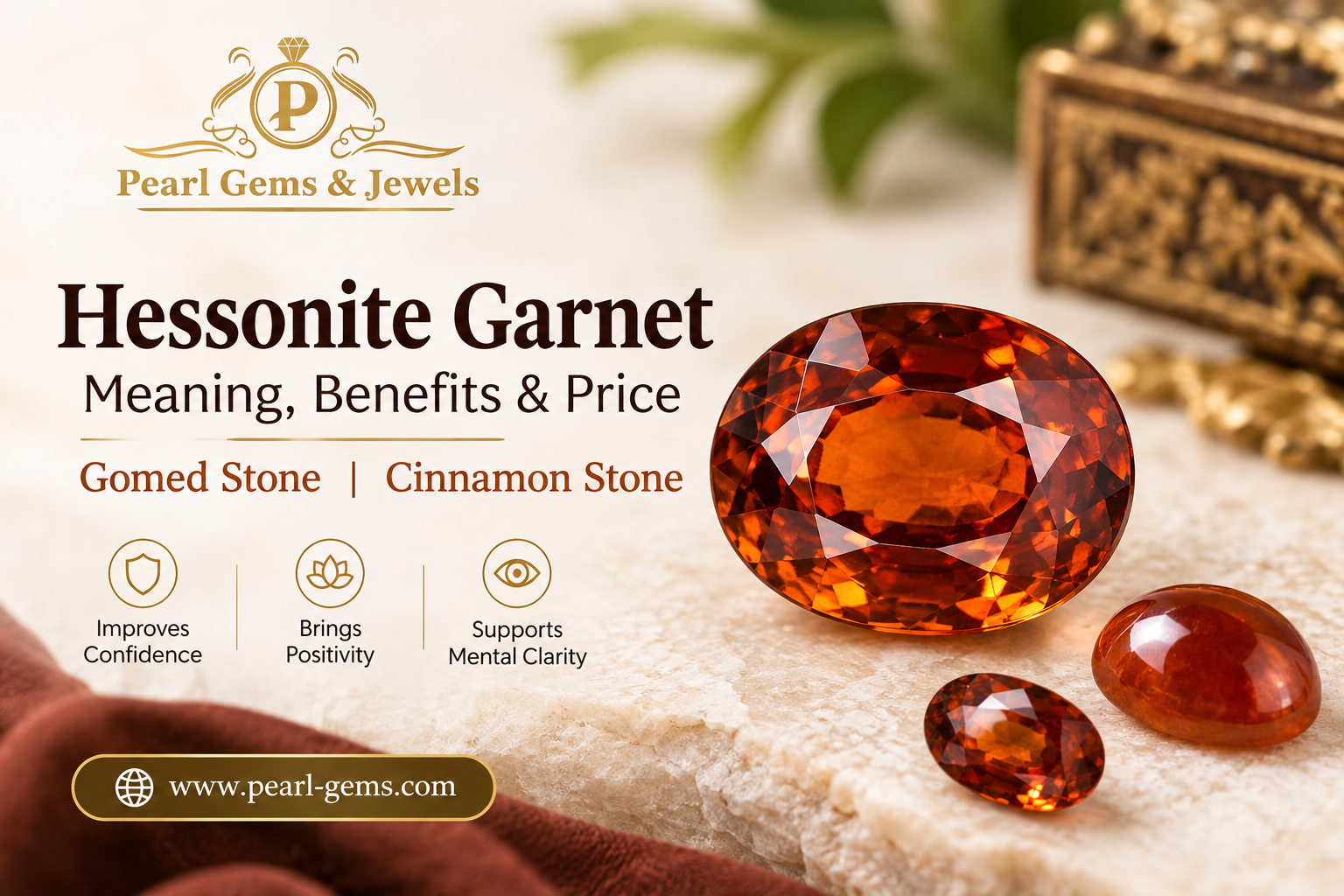
Hessonite garnet is a honey-orange to reddish-brown variety of grossular garnet, widely known across South Asia as Gomed stone. It is valued for its warm colour, its distinctive swirling inclusions and its long place in the region’s gemstone traditions. This guide explains what hessonite is, how hard it is, where it comes from, how to tell a natural stone from an imitation, and what to check before you buy.
What Is Hessonite Garnet?
Hessonite belongs to the grossular species of the garnet family, a calcium aluminium silicate. Its colour ranges from yellowish orange to deep reddish brown, which is why gem traders also call it cinnamon stone. Unlike the deep red garnets most people picture, hessonite has a warm, spicy tone that sets it apart from pyrope and almandine.
The name comes from the Greek word hesson, meaning “inferior”. It does not describe the stone’s beauty. It refers to the fact that hessonite is slightly softer and less dense than most other garnets.
Is Gomed the Same as Hessonite?
Yes. Gomed is the traditional South Asian name for hessonite garnet. When a jeweller in Pakistan or India says Gomed, the natural stone they mean is hessonite. So to answer a common question, Gomed and garnet are not two competing stones: Gomed is one variety of garnet.
The name still matters when you buy. Gomed is sometimes used loosely for glass or for other orange-brown stones, so a stone is only natural hessonite if it has been properly identified.
Hessonite Garnet Properties
| Property | Hessonite |
|---|---|
| Mineral group | Garnet (grossular variety) |
| Chemical composition | Calcium aluminium silicate |
| Colour | Honey yellow, orange, reddish brown |
| Mohs hardness | About 7 (range 6.5 to 7.5) |
| Refractive index | About 1.74 |
| Specific gravity | About 3.65 |
| Transparency | Transparent to translucent |
| Distinctive feature | Swirling, oily “treacle” inclusions |
Hessonite Garnet Hardness
Hessonite garnet hardness is about 7 on the Mohs scale, though individual stones can fall between 6.5 and 7.5. That is close to quartz, so a hessonite stone is durable enough for rings and pendants, but it can still chip if it is knocked against a hard surface. It sits slightly below most other garnets in hardness, which is the origin of its name.
Colour and Inclusions
Natural hessonite ranges from honey yellow and orange to reddish brown. The feature gemmologists look for is the internal “treacle” effect: wavy, oily-looking swirls caused by tiny inclusions. This look is characteristic of hessonite and helps separate it from other garnets, although it should always be confirmed by a gemmologist.
Hessonite vs Other Garnets
Garnet is a family of related gemstones, not a single stone. This comparison shows where hessonite sits among the two best-known red garnets.
| Feature | Hessonite | Pyrope | Almandine |
|---|---|---|---|
| Typical colour | Honey orange to reddish brown | Rich red | Deep red, sometimes violet-tinted |
| Mohs hardness | About 7 (6.5 to 7.5) | About 7 to 7.5 | About 7 to 7.5 |
| Typical look | Warm tone with a swirled interior | Often eye-clean | Dark tone, denser than hessonite |
Browse our full garnet gemstone collection to compare varieties side by side.
Where Is Hessonite Found?
Sri Lanka is regarded as the most important source of hessonite, where it is recovered from gem gravels. Madagascar is another major supplier. Smaller amounts come from Brazil, Canada, Mexico and East Africa. Origin can influence price and buyer preference, but it does not change what the stone is.
Popular Cuts and Jewellery Styles
Hessonite is cut both as faceted stones and as cabochons. Faceted ovals, cushions and rounds show more sparkle, while cabochons give a soft, glowing look that suits the stone’s oily interior. Rings are a popular choice, though pendants and bracelets work well too.
Hessonite Garnet Meaning and Cultural Beliefs
Where the Name Hessonite Comes From
People often ask whether hessonite appears in Greek mythology. The Greek connection is linguistic: the name comes from the Greek hesson, and no well-known Greek myth is attached to the stone. In South Asia the same gem is known as Gomed, a name tied to the region’s own gemstone culture.
Hessonite Garnet Metaphysical Properties and Cultural Beliefs
The points below are traditional beliefs passed down in South Asian gem culture. They are cultural views, not scientific or medical claims. In folk tradition, hessonite is associated with confidence, focus and a sense of protection, and its warm orange colour is often linked with energy and optimism.
For Muslims, gemstones are best understood as natural adornment. In Islamic teaching, benefit and harm come from Allah alone, and no stone can change what has been decreed. Choose hessonite for its beauty and quality, not for a promised outcome.
Hessonite is also one of nine stones traditionally grouped together in Navratna gemstone sets, alongside stones such as Cat’s Eye. See our Navratna stones guide to learn more about that wider tradition and how we present it.
How to Identify Natural Hessonite Garnet
Because Gomed is a popular name in the market, it pays to check a stone before buying. Look for these signs:
- Inclusions: Under a 10x loupe, natural hessonite often shows wavy, oily swirls. Glass imitations more often show round gas bubbles.
- Colour: Be cautious of a flawless, unusually vivid stone sold at a very low price.
- Measurements: A gem laboratory can confirm a refractive index near 1.74 and a specific gravity near 3.65.
- Certificate: Ask for a report from a recognised gemmological laboratory, especially for larger stones.
For a fuller checklist, see our gemstone authentication guide.
Stones That Look Like Hessonite
Several stones are sold under the Gomed name or mistaken for it. Knowing the differences helps you ask the right questions:
- Spessartine garnet: Often a brighter, more vivid orange, with a higher refractive index of about 1.80.
- Citrine: A quartz with a much lower specific gravity (about 2.65) and refractive index (about 1.54), so it feels noticeably lighter than hessonite of the same size.
- Glass: Can copy the colour closely, so look for gas bubbles and confirm with a laboratory test.
What Affects Hessonite Garnet Price?
Price depends on several factors that work together:
- Colour: Rich, even honey-orange to reddish-orange tones are generally preferred.
- Clarity: Eye-clean stones cost more than heavily included ones.
- Carat weight and cut: Larger, well-cut stones are rarer and priced higher per carat.
- Origin: Stones from well-known sources such as Sri Lanka often attract more interest.
- Treatment and certification: Untreated stones with a lab report are easier to price with confidence.
Natural hessonite garnet is generally more affordable than many other coloured gemstones, but quality varies widely, so compare stones by these factors rather than by price alone.
How to Wear and Care for Hessonite Stone Jewellery
Clean hessonite jewellery with lukewarm soapy water and a soft brush, then dry it with a soft cloth. Avoid harsh chemicals and store it separately from harder stones to prevent scratches. Muslim men who wear a ring usually choose silver, as gold is not permitted for men in Islamic teaching.
Frequently Asked Questions About Hessonite Garnet
What is hessonite garnet?
It is a honey-orange to reddish-brown variety of grossular garnet. It is known for its warm colour and swirling inclusions, and in South Asia it is called Gomed stone.
Is Gomed stone the same as hessonite?
Yes. Gomed is the traditional South Asian name for hessonite, and hessonite is a variety of garnet. A natural Gomed stone is therefore a hessonite.
How hard is hessonite garnet?
It has a Mohs hardness of about 7, with a range of 6.5 to 7.5. That makes it suitable for jewellery, although it can chip on impact.
Why is it called hessonite?
The name comes from the Greek word hesson, meaning “inferior”, because the stone is slightly softer and less dense than most other garnets.
Can hessonite be worn every day?
Yes, with reasonable care. At about 7 on the Mohs scale it resists everyday scratching better than softer gems such as pearl or turquoise, but rings should be removed for heavy work to avoid knocks.
Where does hessonite come from?
Sri Lanka is the most important source, followed by Madagascar. Smaller amounts come from Brazil, Canada, Mexico and East Africa.
How can I tell if a hessonite stone is natural?
Check for the characteristic oily swirl inclusions under magnification, be wary of unusually cheap or flawless stones, and ask for a certificate from a recognised gemmological laboratory.
Final Thoughts on Hessonite
This gemstone has a clear identity: a variety of grossular garnet, known as Gomed in South Asia, valued for its honey-orange colour and swirling inclusions. Learn to check colour, clarity, origin and certification, and buy from a seller who can prove the stone is natural. Browse our hessonite garnet and Gomed stone collection to see certified stones