
When it comes to rare gemstones Pakistan produces, the country remains dramatically underappreciated in global gem markets — despite ranking among the top five nations worldwide for untapped gemstone reserves. For the full picture of Pakistan’s gemstone geography, see our gemstones in Pakistan overview. Here, we go deeper: the specific rare and collector-grade stones, where each comes from, and what makes each one genuinely valuable.
What Is the Most Expensive Gemstone in Pakistan?
Fine, unheated ruby from Hunza and Neelum Valley holds the title on a per-carat basis, regularly reaching PKR 400,000–500,000+ per carat for exceptional, certified specimens — rivalling the finest Burmese “pigeon’s blood” rubies. Unheated Kashmir-belt sapphire runs a close second, and an exceptional, minimally treated Swat emerald can reach comparable prices at the top end.
Rarity alone doesn’t always set the record, though. Pakistan’s most valuable single gemstone find wasn’t a ruby at all — it was the “King of Kashmir,” a 440-pound aquamarine crystal unearthed in Shigar Valley in 2019. A comparable Shigar aquamarine specimen previously sold for $8 million at international auction, reflecting mineral-specimen and rarity value rather than typical per-carat gem pricing.
Swat Emerald (Zamurd) — The Forest-Green Jewel of Khyber Pakhtunkhwa
Primary origin: Swat Valley, Malakand Division, KPK Rarity level: High Collector appeal: ★★★★★
Swat emeralds are among the most significant rare gemstones Pakistan produces. Found embedded in talc-carbonate schists in the Swat Valley, these stones form through a rare geological process involving the metamorphism of oceanic crust along the Main Mantle Overthrust — a mechanism first documented by geologists Kazmi and Snee in 1989. The result is a vivid, warm green hue that distinguishes Swat emeralds from the cooler, bluer greens typical of Colombian stones.
Reserves in Swat Valley are estimated at approximately 70 million carats, making the region one of the largest emerald deposit zones in Asia. Mining is predominantly artisanal, carried out by local communities using methods passed down across generations — an approach that preserves the stones’ integrity but keeps high-quality material genuinely scarce.
What to look for when buying:
- Deep, vivid green with warm undertones (not yellowish or overly blue)
- Inclusions are expected and do not reduce authenticity
- GRS or GIA origin certification adds significant value
- Under-one-carat clean material is rare and highly sought after by collectors
Katlang Pink Topaz — Pakistan’s Rarest Imperial Gem
Primary origin: Katlang, Mardan District, KPK Rarity level: Exceptional Collector appeal: ★★★★★
If there is one gemstone that defines Pakistan’s unique contribution to the global rare gem market, it is Katlang pink topaz. Found in calcite and quartz veins within carbonate rocks in the Katlang mine, this stone produces a uniquely soft, pastel pink to purplish-pink color that no other topaz deposit in the world replicates.
Katlang pink topaz is classified as a variety of imperial topaz, making it exceptionally desirable. With estimated reserves of approximately 9 million carats, the mine has supplied international gem markets for generations — but high-quality specimens with saturated color and clean clarity have become increasingly difficult to source, driving prices upward year after year.
Why jewelry makers prize Katlang topaz:
- The soft pink hue pairs beautifully with rose gold and white gold settings
- Hardness of 8 on the Mohs scale ensures excellent durability for daily wear
- Faceted stones produce exceptional brilliance with minimal treatment
- Origin-certified pieces carry considerably higher resale value
Hunza & Neelum Ruby (Yaqoot) — Fire from the Mountains
Primary origin: Hunza Valley (GB) and Neelum Valley (Azad Kashmir) Rarity level: Very High Collector appeal: ★★★★☆
Pakistani rubies are sourced from two distinct regions, each producing stones with their own character. The Hunza Valley yields pink-to-red ruby crystals from metamorphic dolomite marble deposits, while Neelum Valley in Azad Kashmir produces high-quality rubies noted for richness and clarity that rivals the legendary output of Myanmar’s Mogok mines.
Ruby and sapphire deposits in these northern regions form through regional metamorphism of marbles intercalated in garnetiferous mica schists — a process enhanced by Tertiary granite intrusions that concentrate corundum minerals at depths equivalent to temperatures around 600°C. The Nangimali, Batakundi, and Basil mines in Azad Kashmir are among the most productive active sites.
Key characteristics of Pakistani rubies:
- Pink-red to deep red color range
- Natural fluorescence that creates a glowing appearance under UV light
- Marble-hosted origin leaves distinctive inclusion patterns identifiable by gemologists
- Unheated, untreated specimens command a significant premium globally
Kashmir & Batakundi Sapphire (Neelam) — The Velvet Blue Standard
Primary origin: Batakundi (AJK), Hunza Valley (GB) Rarity level: Extremely High Collector appeal: ★★★★★
Kashmir sapphire is globally acknowledged as the benchmark against which all other blue sapphires are measured. Its signature “cornflower blue” color — a rich, velvety medium blue that appears to glow from within — comes from fine silk-like rutile inclusions that scatter light in a way unique to this geological origin.
What makes Kashmir and Pakistani sapphires so valuable is not just the color — it’s the geological rarity of the formation conditions and the extremely limited volume of gem-quality material produced. Fine, unheated Kashmir-origin sapphires regularly achieve some of the highest per-carat prices of any colored gemstone at international auctions.
Shigar & Skardu Aquamarine — The Giant Blue Beryl
Primary origin: Shigar Valley, Haramosh Valley, Nager Valley (Gilgit-Baltistan) Rarity level: Moderate to High Collector appeal: ★★★★☆
Pakistan’s Gilgit-Baltistan region is one of the world’s premier sources of aquamarine — the blue-green variety of beryl prized for its transparency and calm blue color. The Shigar Valley in particular has produced extraordinary collector specimens, including the “King of Kashmir” aquamarine mentioned above.
Quality indicators:
- Clarity: highly transparent material is most valuable
- Color: pure blue over blue-green commands a premium
- Size: Pakistan consistently produces unusually large crystals
Kohistan Peridot (Zabarjad) — The Olive Green Treasure
Primary origin: Kohistan District, KPK Rarity level: Moderate Collector appeal: ★★★☆☆
Peridot found in Kohistan is widely regarded as among the finest in the world. Reserves in the region exceed 10 million carats, making Pakistan a globally significant producer of this vivid green-to-olive stone, distinguished by consistent color saturation and relatively clean clarity compared to material from other origins.
Lapis Lazuli (Lajward), Tourmaline (Beyroj) & Other Notable Pakistani Gems
Pakistan’s gemstone diversity extends well beyond its headline stones:
Lapis Lazuli (Chagai, Balochistan): A deep blue opaque stone used for millennia in jewelry, carvings, and ornamentation. Pakistan’s lapis deposits produce material with a rich, uniform blue.
Tourmaline (Gilgit-Baltistan & KPK): Produced in a remarkable range of colors — pink, green, blue, and bi-color specimens — from deposits across Gilgit-Baltistan and Stak Nala. See our dedicated Beyroj / Tourmaline price guide for current rates.
Spinel (Hunza Valley): Natural spinel occurs in red, pink, and orange hues. Unheated red spinel is one of the most undervalued gems on the market today — a ruby-like appearance at a fraction of the cost.
Kunzite and Morganite (Skardu area): The Skardu pegmatite fields yield pastel-colored kunzite (pink spodumene) and morganite (pink beryl), both popular with contemporary jewelry designers.
Hessonite Garnet: Found across the northern regions, hessonite garnet in orange-brown tones is a durable, affordable gemstone ideal for traditional jewelry settings.
How to Buy Rare Gemstones in Pakistan
Purchasing rare, high-value gemstones in Pakistan calls for a bit more diligence than an everyday stone purchase:
Certification matters more at this level. For emeralds, rubies, sapphires, and topaz above collector value, insist on a certificate from GIA, GRS, or AGL. For the full rundown of what a certificate proves and which lab to use for which stone, see our gemstone certificate Pakistan guide.
Treatment status changes the math. Most emeralds are oiled — standard and acceptable — but the degree of enhancement matters. Unheated rubies and sapphires command real premiums, and that claim needs lab backing. Our asli vs naqli guide covers how to verify this yourself.
Source directly when possible. Pakistan’s major rare-gemstone trading hubs include Peshawar’s Karkhano Market, the gem bazaars of Quetta, and the wholesale dealers of Lahore. Direct-from-mine sourcing eliminates multiple middlemen and offers better pricing.
Know rough vs. faceted value. Rough gemstones require cutting and polishing before use in jewelry. Faceted, certified stones carry higher prices but are ready for setting — collectors often prefer high-quality rough specimens for display purposes instead.
Verify before you invest. For any stone above PKR 50,000 in value, independent verification by a local gemologist is worthwhile. Pakistan has trained gemologists in Lahore, Karachi, and Peshawar who can assess stones before purchase.
FAQs About Rare Gemstones in Pakistan
What is the most expensive gemstone in Pakistan? Fine, unheated ruby from Hunza and Neelum Valley commands the highest per-carat prices, up to PKR 500,000+ for exceptional certified specimens, with unheated Kashmir sapphire close behind. The single most valuable Pakistani gem find on record, however, was a giant Shigar Valley aquamarine specimen — sold for $8 million at auction.
What is the rarest gemstone found in Pakistan? Katlang pink topaz is widely considered the rarest gemstone uniquely associated with Pakistan. Its distinctive soft pink to purplish-pink color is not replicated by any other deposit globally, and high-quality specimens are increasingly scarce.
Are Pakistani emeralds valuable? Yes. High-quality Swat emeralds with deep color, good clarity, and origin certification are genuinely valuable and compete with Colombian emeralds internationally. Fine unheated, minimally treated material commands premium prices among collectors worldwide.
Which province has the most gemstone deposits in Pakistan? Gilgit-Baltistan and Khyber Pakhtunkhwa are the most gemstone-rich provinces. GB produces aquamarine, ruby, sapphire, topaz, tourmaline, and spinel, while KPK is the source of Swat emeralds, Katlang topaz, and Kohistan peridot.
How can I verify if a Pakistani gemstone is authentic? Get a certificate from a recognized gemological laboratory and, for high-value stones, a second opinion from a local gemologist before you pay. Our full authenticity testing guide walks through every check.
Is it legal to buy and sell gemstones in Pakistan? Yes. The government regulates commercial mining operations, but individual purchase, sale, and export of gems for personal or commercial purposes is permitted subject to applicable customs regulations.
Pakistan’s Rare Gemstone Heritage
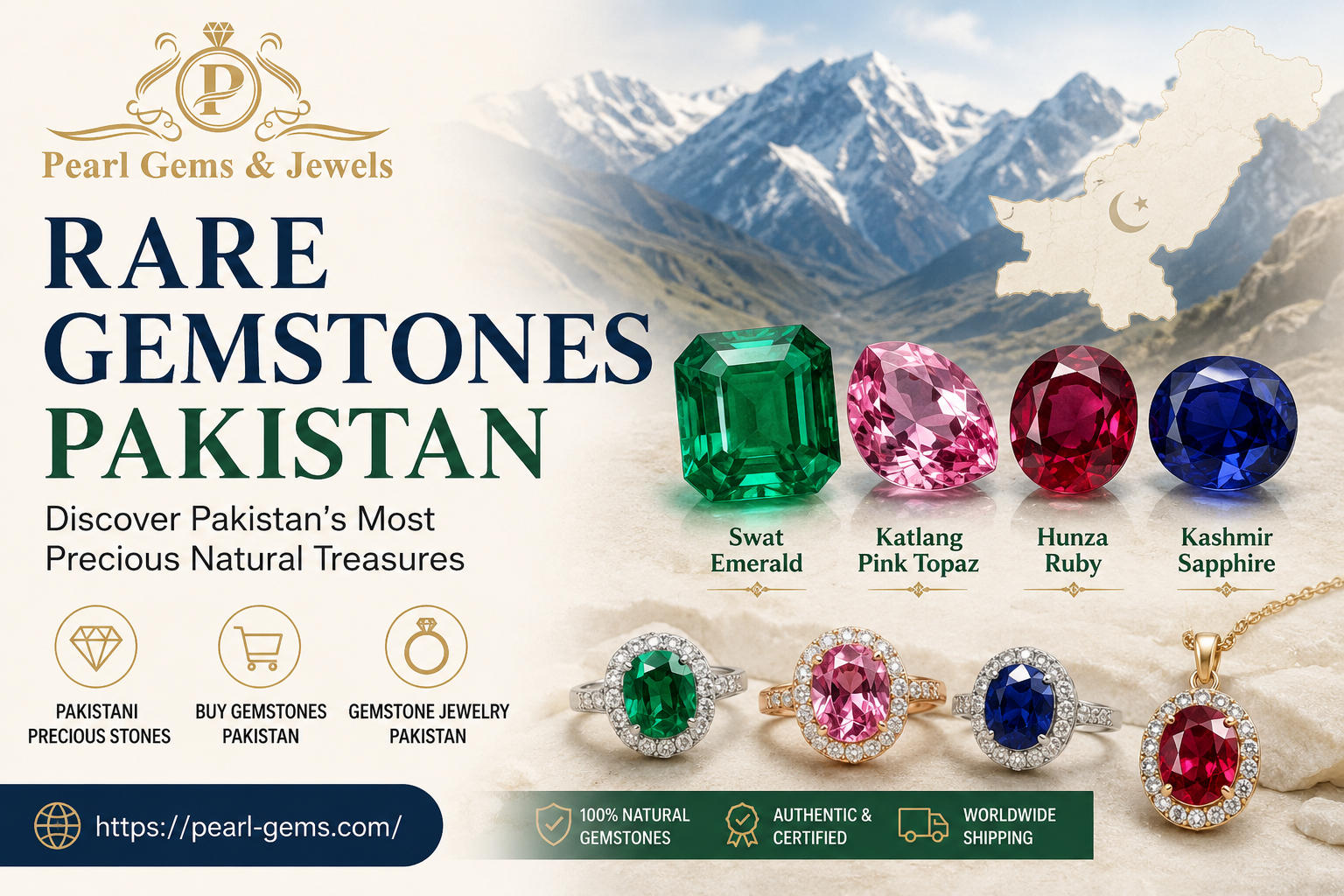
From the vivid green of a Swat emerald and the pastel pink of Katlang topaz to the velvety blue of a Batakundi sapphire and the fiery red of a Hunza ruby, rare gemstones Pakistan produces are world-class by every measure. Know what you’re buying, demand certification for high-value stones, and source from reputable dealers.
Ready to begin your collection?
Explore certified Pakistani gemstones from Pearl-Gems.com, or consult our team before any purchase above PKR 50,000.