

Gemstones have held a place of reverence in Islamic culture for over fourteen centuries. From the rings worn by the Prophet Muhammad ﷺ to the treasures described in sacred texts, gemstone benefits in Islam extend far beyond mere aesthetics. For Muslim collectors, jewelry makers, and buyers, understanding the spiritual and traditional significance of these stones adds an entirely new dimension to owning them.
This guide covers the most important Islamic gemstones — their names, their roots in tradition, their believed benefits, and a vital theological reminder that grounds their use within the framework of tawakkul (trust in Allah alone).
The Islamic Framework: Why Gemstones Matter
Before exploring individual stones, it is essential to understand the Islamic perspective on wearing them. Scholars across traditions agree on one foundational principle: no stone holds independent power. Any benefit a gemstone provides comes solely by the will of Allah ﷻ. Treating a stone as inherently powerful or necessary for protection would contradict Islamic monotheism (tawhid).
Within that boundary, wearing gemstones is widely considered permissible (mubah) and in some cases a recommended practice (sunnah), particularly for rings. The tradition draws from the practice of the Prophet ﷺ himself, his companions, and narrations preserved in classical Islamic literature.
Surah Ar-Rahman (55:22) references two of the most prized natural treasures — pearls and coral — emerging from the meeting of two bodies of water, affirming that Allah ﷻ created these gifts for humanity. This Quranic reference has long been understood by scholars and collectors alike as recognition of natural gemstones as divine blessings (ni’mat).
Which Stones Are Mentioned in the Quran?
The Quran references precious materials primarily in the context of describing the blessings of Paradise and the signs of Allah’s creation. Pearls (lu’lu’) and coral (marjan) are specifically named in Surah Ar-Rahman (55:22). Ruby (yaqoot) is referenced in classical Quranic commentary in descriptions of the inhabitants of Jannah. These references are not prescriptions for wearing specific stones but serve as testimony to Allah’s creative bounty.
The broader tradition of Islamic gemology developed through the Hadith literature, the writings of companions, and classical scholars — particularly within the Shia tradition, which contains a rich body of narrations on the spiritual properties of individual stones.
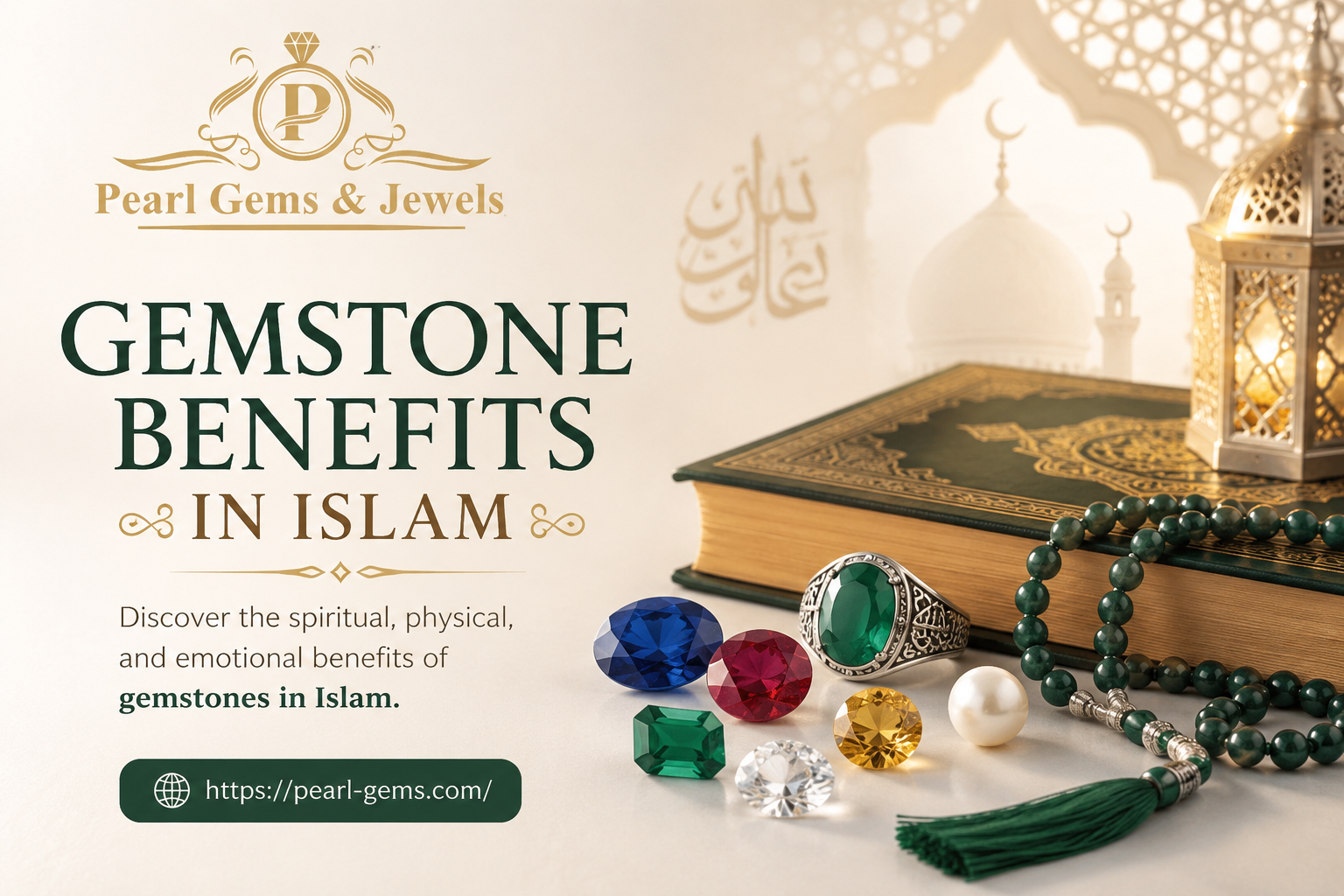
The Most Important Islamic Gemstones and Their Benefits
1. Aqeeq (Carnelian / Agate) — The Stone of the Sunnah
Aqeeq is the most celebrated gemstone in Islamic tradition and the one with the strongest basis in Sunnah. The narration of Anas ibn Malik, recorded in classical hadith collections, confirms that the Prophet Muhammad ﷺ wore a silver ring set with an Abyssinian stone — widely identified as aqeeq (carnelian). This makes wearing an aqeeq ring a recognized Sunnah practice observed by millions of Muslims worldwide.
Classical Shia literature, particularly Hilyat al-Muttaqeen by Sheikh Mohammed Baqir Al-Majlisi, contains multiple narrations attributing significant benefits to aqeeq: it is said to ward off poverty, dissolve discord from the heart, and bring safety during travel. It is also traditionally associated with calming temperament, strengthening concentration, and providing protection in times of difficulty.
For collectors and jewelry makers, aqeeq is available in deep red, orange, and banded varieties. Red carnelian set in silver is the most traditional form, consistent with Sunnah guidelines that men wear silver rather than gold rings.
Key traditional benefits: Warding off poverty · Emotional balance · Protection during travel · Strengthening of faith
2. Feroza (Turquoise) — The Stone of Provision and Protection
Feroza (also spelled Firoza) is one of the most beloved Islamic gemstones after aqeeq. Its deep blue-green color has made it a fixture of Islamic jewelry for centuries, particularly in Iranian, Ottoman, and Central Asian traditions.
In Shia tradition, Imam al-Sadiq is reported to have said: “Whoever wears a turquoise ring will never be destitute.” This narration, preserved in classical Islamic sources, has given feroza a powerful association with rizq (provision) and financial protection.
Beyond sustenance, feroza is traditionally associated with protection from the evil eye (nazar), inner peace, and relief from anxiety. Classical sources also note that merely looking at a feroza stone is believed to strengthen eyesight. One narration preserved in Shia sources describes Allah ﷻ as not refusing the supplication of a servant who raises hands wearing a turquoise ring — making it particularly favored for those who engage in frequent du’a.
For buyers, genuine feroza sourced from Iran (Neyshabur) and Afghanistan commands the highest regard in Islamic collecting circles. Look for natural, untreated stones for the most authentic pieces.
Key traditional benefits: Protection from poverty · Acceptance of supplication · Shield against the evil eye · Mental peace
3. Yaqoot (Ruby) — The Stone of Nobility and Honor
The ruby occupies a position of exceptional prestige in Islamic tradition and scholarship. Described in Islamic texts as one of the gemstones adorning Paradise, yaqoot has long been associated with nobility, honor, wisdom, and divine favor.
Classical Islamic scholarship describes ruby as symbolizing spiritual dignity. Among Muslim rulers across history — from the Mughals to the Ottomans — rubies were prized as markers of authority and divine blessing. The deep red color is understood in Islamic aesthetic tradition as reflecting strength, life force, and the fire of sincere faith.
In Shia narrations recorded at Al-Islam.org, ruby is described as beneficial for physical vitality, promoting compassion, and being particularly valued alongside emerald for nurturing love and warmth in relationships. Today, yaqoot remains a top choice for ceremonial jewelry, wedding rings, and heirloom collections within Muslim communities.
Key traditional benefits: Dignity and honor · Compassion and love · Spiritual strength · Leadership and wisdom
4. Zabarjad (Peridot) — The Stone of Paradise
Zabarjad — known in the West as peridot — holds a distinctive position in Islamic gemology. Some Islamic texts describe it as a stone that adorns Jannah (Paradise), and its vivid olive-green color is seen as a symbol of divine life, renewal, and creation.
Classical Islamic sources describe zabarjad as supporting positive character development, encouraging generosity and kindness, and uplifting the spirit. Traditional knowledge also attributes to it benefits for the liver, digestion, and skin, though these are understood within the framework of Allah’s will rather than as guaranteed cures.
For jewelry makers, zabarjad’s rich green tone pairs beautifully with gold and silver settings and has seen renewed popularity among collectors seeking gemstones with authentic Islamic heritage roots.
Key traditional benefits: Spiritual growth · Generosity and good character · Inner lightness · Connection to Jannah’s symbolism
5. Zumurrud (Emerald) — The Stone of Healing and Clarity
The emerald (zumurrud) has been prized across Islamic civilization for its stunning green brilliance and its attributed healing qualities. A narration attributed to the Prophet ﷺ in classical literature states that emerald can help repel poverty, making it a stone associated with both material and spiritual abundance.
In Shia tradition, emerald is especially recommended for pregnant women, with narrations suggesting it eases childbirth. It is also traditionally linked to supporting the nervous system, promoting mental clarity, and nurturing compassion alongside ruby. Historically, the Mughal Empire produced some of the world’s most celebrated emerald jewelry, with Quranic inscriptions carved into the stones — a fusion of artistic excellence and Islamic devotion.
Key traditional benefits: Healing and clarity · Support during pregnancy · Repelling poverty · Nervous system support (traditional belief)
6. Durr-e-Najaf — The Stone of Remembrance
Durr-e-Najaf is a rare variety of clear quartz found near Najaf, Iraq — a city of immense spiritual significance in Islam. Particularly revered in Shia tradition, this stone is associated with increasing dhikr (remembrance of Allah) and enhancing focus during prayer.
Classical narrations preserved in Shia sources describe wearing a Durr-e-Najaf as spiritually equivalent in reward to performing a Hajj or Umrah pilgrimage — though scholars clarify this refers to spiritual merit in intention and remembrance, not a substitution for the pillar of Hajj itself.
For collectors, Durr-e-Najaf is a highly meaningful keepsake, particularly for those who value gemstones closely tied to Islamic spiritual geography and tawassul (seeking nearness to Allah through blessed means).
Key traditional benefits: Increased remembrance of Allah · Enhanced focus in prayer · Deep spiritual connection
Wearing Gemstones the Islamic Way: Essential Guidelines
For those purchasing or collecting Islamic gemstones, the following guidelines reflect the broad scholarly consensus:
Material for men
Silver is the only permissible metal for men’s rings. Gold rings are not permitted for men in Islamic law. The Prophet ﷺ wore a silver ring, and this practice is widely followed.
Weight for men
Classical scholarship indicates that a man’s ring stone should not exceed approximately 4–4.5 masha (a traditional unit of weight). Wearing oversized or multiple rings for show contradicts the spirit of simplicity in adornment.
Women’s adornment
Women may wear gemstones in both gold and silver settings, with no weight restriction equivalent to that for men.
Belief and intention
The stone is a sabab (a means) — a divine gift. Any benefit comes from Allah alone. Wearing a stone with the belief that it has independent power is theologically problematic. The correct intention is gratitude for a beautiful creation and hope for Allah’s mercy and blessing.
Authenticity matters
For collectors and buyers, natural, untreated gemstones are most consistent with the spirit of the tradition. Many stones on the market are synthetically produced or heavily treated; sourcing from reputable dealers ensures you receive genuine pieces worthy of their Islamic heritage.
Gemstones in Islamic Jewelry Making
For jewelry makers, Islamic gemstones offer one of the richest design traditions in the world. Ottoman, Mughal, Persian, and Arab jewelry traditions each developed distinct aesthetics around these stones — from the geometric inlay work of Mughal emerald rings to the fine filigree silver settings of Ottoman aqeeq pieces.
Traditional Islamic jewelry design often incorporates Quranic inscriptions, the basmala, or the names of Allah engraved alongside or on the stone itself. This combination of sacred text and sacred material creates pieces that carry both artistic and devotional significance — a distinction that sets Islamic gemstone jewelry apart in the global collectors’ market.
Whether you are designing a custom ring, sourcing cabochons for a bracelet, or building a collection of loose stones with Islamic significance, understanding the tradition behind each gem transforms the creative process.
Frequently Asked Questions
Which stone is most recommended in Islam? Aqeeq (agate) holds the strongest basis in Islamic tradition, as it is confirmed through narrations that the Prophet Muhammad ﷺ wore an aqeeq ring. It is considered a Sunnah to wear one.
Which gemstones are mentioned in the Quran? Pearls (lu’lu’) and coral (marjan) are directly named in Surah Ar-Rahman (55:22) as gifts from Allah’s creation. Ruby is referenced in classical Quranic commentary in descriptions of Paradise.
Is wearing gemstones shirk (polytheism)? No — provided the wearer’s belief is that any benefit comes from Allah alone. Treating a stone as having independent power would be incorrect. Wearing it as a blessed means (sabab), with full trust in Allah, is permissible and in some cases recommended.
Can women wear Islamic gemstones? Yes. Women may wear gemstones set in both gold and silver. There are no weight or type restrictions equivalent to those that apply to men.
What is the benefit of Feroza (Turquoise) in Islam? Feroza is traditionally associated with protection from poverty, acceptance of supplication, and protection from the evil eye, based on narrations in classical Islamic sources.
What is Zabarjad in Islam? Zabarjad is the Arabic name for peridot. It is described in some Islamic texts as a stone associated with Paradise and is traditionally valued for promoting good character, generosity, and spiritual growth.
Discover Authentic Islamic Gemstones
Whether you are a collector seeking gemstones with genuine Islamic heritage, a jewelry maker sourcing stones for traditional designs, or a buyer looking for a meaningful gift, the world of Islamic gemstones offers extraordinary depth. Each stone carries centuries of tradition, scholarship, and craftsmanship.
Browse our collection of authentic Islamic gemstones
from Yemeni aqeeq and Iranian feroza to natural zabarjad and zumurrud — and find the piece that resonates with your tradition and intention. Contact us for custom sourcing, loose stones, and bespoke jewelry pieces crafted in the spirit of Islamic heritage.